Marquette $60M Business School on Track to Open Dec. 2022

Milwaukee's Marquette University is on track to complete construction of a new, $60-million business school in a year. According to the institution, the facility is the largest donor-funded one in its history.

The 100,000-square-foot structure is designed to include collaborative classroom, lab and study spaces; an event space; faculty offices; and areas for programmatic centers of excellence. The first floor will provide wrap-around student support with advising, a student success center and a business career center.

The new space will also include a café, where "collisions between our students, our faculty and our stakeholders will happen," according to Tim Hanley, interim dean of the College of Business Administration.
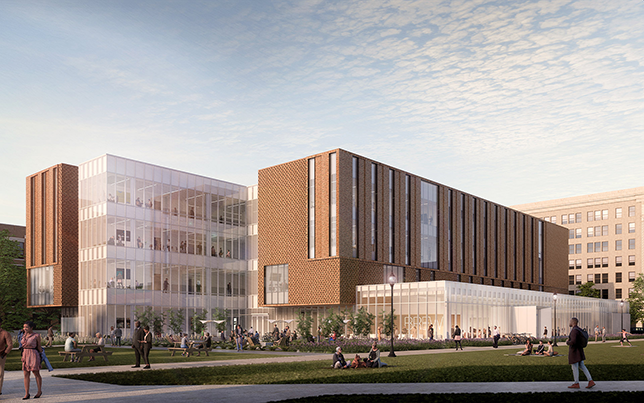
Marquette University Business School

As people walk into the building, they'll enter a "light-filled atrium" that leads to a planned Applied Investment Management Lab, "where we think the action's going to happen," said Hanley. "I think this facility will be a gamechanger for the university across all of our landscape."

The new facility will also house innovation leadership programs, including Excellence in Leadership (E-LEAD) and interdisciplinary Bridge to Business for Engineers. Campus officials noted that Its closeness to the university's College of Engineering "will help foster creative collisions of thought and perspective that fuel an innovative mindset."

The four-story building design is being led by Vice President for Planning and Facilities Management, Lora Strigens, and her team, in partnership with architectural firms BNIM of Kansas City and Milwaukee-based Workshop Architects. Findorff is constructing the building

The building is scheduled to open in December 2022.

About the Author

Dian Schaffhauser is a former senior contributing editor for 1105 Media's education publications THE Journal, Campus Technology and Spaces4Learning.

Featured

  • Rethinking K-12 Schools as a Continuous Learning Experience

    Most students move through three or more separate facilities during their K-12 journey, yet the built environments they encounter at each stage have traditionally been designed in isolation, with little continuity in spatial language, learning philosophy, or physical resources. Each new school is a reset with different layouts, learning models, expectations, and ways of moving through a building. The next generation of school design is making the case that the first day of kindergarten and the last day of high school can and should feel connected through common support systems and infrastructure in the physical environment.

  • Spaces4Learning Announces 2026 Product Award Winners

    Spaces4Learning has just announced the winners of the 2026 Product Awards! The award program spotlights outstanding product development achievements of manufacturers and suppliers whose products or services are considered to be particularly noteworthy in their ability to enhance K–12 and higher-education learning environments.

  • Wold Completes Geothermal Projects at Two Minnesota Schools

    Wold Architects & Engineers recently announced that it has completed two geothermal expansion projects for Mounds View Public Schools in Shoreview, Minn., according to a news release. The work at Highview Middle School and Irondale High School serves the district’s long-term goal of reducing energy costs and dependency on non-renewable fuel sources, as well as improving building performance.

  • Cal Poly Humboldt Starts Construction on Healthcare Education Hub

    California State Polytechnic University, Humboldt in Arcata, Calif., recently announced that work has begun on a renovation project that will turn the Stewart Building into a new Healthcare Education Hub, according to a news release. The university is partnering with Sundt Construction Inc. for construction services.