STEAM-Focused Elementary School Kicks Off Whole Site Modernization
Franklin Elementary STEAM Magnet School, part of the San Diego Unified School District in San Diego, Calif., recently broke ground on a whole site modernization project. The project will see the new construction of a two-story classroom building, as well as renovations and modernization to all classrooms and a wide variety of campus enhancements, according to a news release.
“Franklin has served generations of students in the Kensington and City Heights communities for 93 years and counting,” said Dr. Lamont Jackson, Superintendent of the San Diego Unified School District. “We’re excited to bring Franklin students new facilities and technology that will enhance their educational experience, while creating new memories that will carry onto the next generation.”
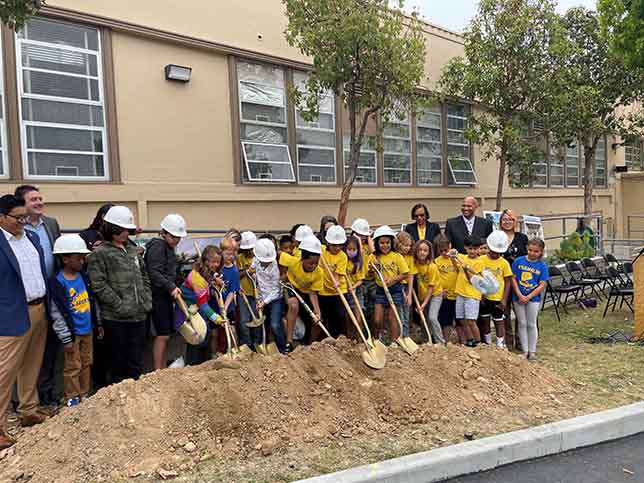
According to a news release, the new classroom building will feature amenities like collaborative workspaces, staff lounge and food services kitchen. The student dining area will be expanded to include an outdoor shade canopy. Safety and security improvements are set to include a student services suite; a single, monitored point of entry; a modern public address and intercom system; cameras; fire alarm and intrusion systems; and secure fencing around the entire perimeter. The school will also see renovations to its kindergarten and higher-grade playgrounds, set to include a learning garden with a shade canopy and a landscaped bioretention basin.
“You walk onto our campus and you can see and feel the history,” said Franklin Principal Melissa Roy-Wood. “But you also see aging buildings and a need for expanded play areas. So, we are beyond ecstatic about this makeover.”
The project is being funded through Propositions S and Z, as well as Measure YY, both local bond measures approved by local voters. The district partnered with Safdie Rabines Architects for site design and with C.W. Driver for construction. Construction is scheduled for completion in late 2024.
About the Author
Matt Jones is senior editor of Spaces4Learning. He can be reached at [email protected].