Teknion Introduces Space-Saving Kupp Flip-Top Tables
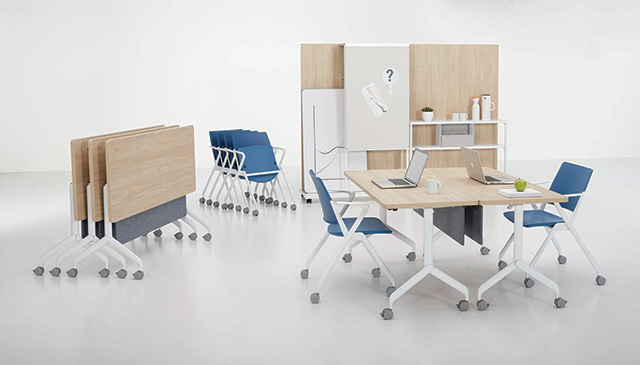
Kupp Flip-Top Tables

Teknion has launched a new addition to its Kupp furniture collection: the Kupp Flip-Top table. Featuring angled legs that enable straight-line nesting and integration with the Kupp horizontal nesting chair, the tables are designed for flexibility and efficient storage, the company said in a news announcement.

The tables feature a surface-long handle that allows users to flip the tabletop for storage or reconfiguration, and the work surface is finished on both sides, providing a "clean and polished aesthetic" in both the horizontal and vertical position, the company said. Customization and accessory options include a modesty panel, power/data cut-out, and bag hook. The tables are available in depths of 24 inches and 30 inches and in widths ranging from 42 inches to 72 inches, providing a wide variety of size options.

"With an emphasis on practicality, style, and adaptability, these tables empower individuals and organizations to create dynamic and efficient workspaces," said Martin Geoffroy, director of product management - expansion at Teknon, in a statement. "Its versatile linking capability opens up endless possibilities for creating collaborative work areas, making them an ideal choice for dynamic and evolving workspaces."

For more information, visit the Kupp site.

About the Author

Rhea Kelly is editor in chief for Campus Technology, THE Journal, and Spaces4Learning. She can be reached at [email protected].

Featured

  • University of Tennessee at Chattanooga Launches New Emergency Communications System

    The University of Tennessee at Chattanooga (UTC) recently deployed a new emergency notification and incident management system for its campus, according to a news release. The university partnered with 911Cellular to launch Safe@UTC, a smartphone app allowing university officials to communicate and respond during emergency situations.

  • Spaces4Learning Trends & Predictions for Educational Facilities in 2026: Part II

    As education leaders look toward 2026, the design of K–12 and higher education facilities is being reshaped by powerful, converging forces. Survey respondents point to the rapid growth of Career and Technical Education, deeper alignment with workforce and industry needs, and the accelerating influence of AI and emerging technologies.

  • University of Arizona Approves New Residence Hall

    The Arizona Board of Regents recently approved plans for a new residence hall at the University of Arizona in Tucson, Ariz., according to a news release. The new facility is scheduled to open in fall 2028 and have the capacity for more than 1,200 students, enforcing a new university expectation that all first-year students live on campus.

  • How a Portable Sink Helped an Art Classroom Run More Smoothly

    Classroom design decisions can have outsized effects on instructional time and safety at schools juggling mismatched infrastructure, strict budgets, and crowded schedules — particularly in the arts. Between spilled paint and dirty brushes, art classes run smoother with a sink in the studio. But many schools don’t have a sink in every art classroom.