University of Connecticut Upgrades Basketball Facility’s AV Systems
The University of Connecticut recently partnered with Metinteractive to upgrade the AV systems of the Gampel Pavilion basketball facility on its campus in Mansfield, Conn., according to a news release.
The work includes new LED videoboard displays; new seating for the geodesic dome structure’s inner bowl; upgrades to the existing broadcast system to boost live production capabilities; and future-planning by linking the Pavilion to the Riazza Performance Center’s control room as a secondary control room for athletic events.
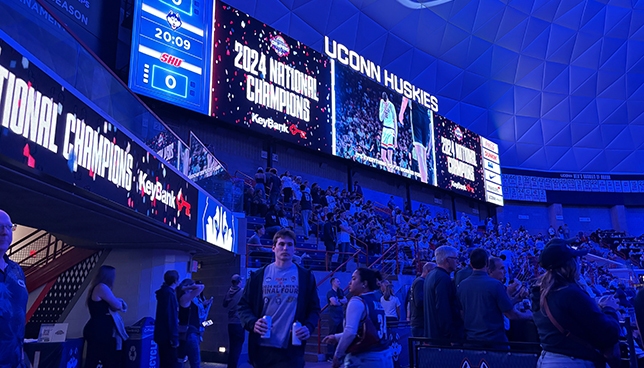 University of Connecticut Gampel Pavilion
Photo courtesy of Metinteractive
According to the news release, “The control room was outfitted with two larger ElationLogic DV65 monitors, a Ross Ultrix router, Ross XPression motion graphics render engine, an Evertz DreamCatcher DC-ONE replay platform and a master clock for AV synchronization. Metinteractive installed fiber to connect the control room to two much larger Daktronics LED videoboards mounted at each short end of the court and integrated a Ferrofish Pulse16 MX AD/DA converter with the displays’ video content.”
Metinteractive has partnered with the university on a number of recent projects, including the UConn Freitas Volleyball, Toscano Hockey arena, the student rec center, the Athletic District Development, and exhibits on the UConn Hartford campus, according to the news release.
“UCONN is our home team – we’re big Huskies fans,” said Jeff Mele, Metinteractive’s Chief Commercial Officer and Project Executive for Gampel Pavilion. “As taxpayers in the state, it’s also important to us to see that tax dollars and donor dollars are spent wisely. Gampel Pavilion is part of the continuing effort to standardize and connect facilities across all sports on the UCONN Storrs campus,” he explains. “Facilities that are fragmented often require more support and more initial capital expenditures due to their individual, complete systems. Although standardization and connectivity add complexity, the long-term results are lower costs and greater operational flexibility.”
About the Author
Matt Jones is senior editor of Spaces4Learning. He can be reached at [email protected].