Wood Makes the Grade For Student Housing
- By Lauren Rockart
- 03/01/15
PHOTOS © 2014 MARK HERBOTH PHOTOGRAPHY LLC
Faced with today’s economic pressures, university officials and developers of state-funded education projects are challenged with providing high-quality buildings for students that stay within budget while meeting tough safety and performance standards. For this reason, wood is increasingly becoming the material of choice for student housing. This is showcased by several projects across the U.S. where wood framing was chosen for its flexibility, affordability and speed of construction.
Residence halls in particular leave minimal leeway in construction deadlines, as new student housing projects simply must be finished in advance of the new school year. Considering this unique challenge, the shorter construction times associated with wood buildings can be a major asset to project teams. Whether the structure uses traditional wood framing, panelized products, engineered wood or prefabricated assemblies, wood construction is usually faster than other building materials. Additionally, because wood is so commonly used there is a large pool of workers typically available in most areas with relevant experience, helping to minimize construction delays and labor costs.
PHOTOS © 2014 MARK HERBOTH PHOTOGRAPHY LLC
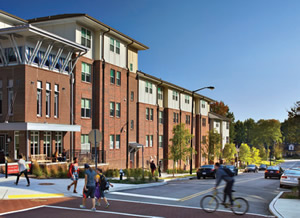
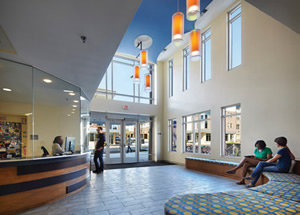
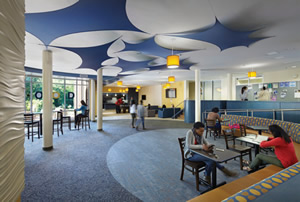
WOOD WORKS. Cost savings was also the primary reason architects used wood for Spartan Village, a four-building, 800-room student housing project for the University of North Carolina at Greensboro. After comparing costs of a wood-framed system to metal studs, cold-form metal framing and long-span concrete deck as an alternative system, the project’s owner and architects chose wood because of the significant cost savings ($15 per square foot on a 385,000-square-foot project) and because wood framing helped speed construction on the large project.
When architecture firm Lord Aeck Sargent was tasked with designing Spartan Village, an 800-bed student housing project for the University of North Carolina at Greensboro, they worked closely with the project owners to examine costs of a wood-framed system compared to an alternative system using metal studs, cold-form metal framing and long-span concrete deck. While they had expected the wood framing to allow them a small savings, they were surprised to find that they would actually save $15 per square foot compared to other building systems. In total, the owners realized savings of roughly $5.7 million on the 385,000-square-foot four-story project by using wood while producing a durable end result that was aesthetically pleasing for residents.
With record enrollment numbers at colleges and universities around the country, institutions are looking for cost-effective solutions to expand their student housing capabilities. Wood’s combination of cost savings, shorter construction times and aesthetic beauty is making it an increasingly attractive choice for mid-rise campus construction.
This article originally appeared in the issue of .
About the Author
Lauren Rockart is a principal at architecture firm Lord Aeck Sargent (www.lordaecksargent.com), based in Chapel Hill, NC.