Innovative Table Component Enhances Safety and Bottom Line
tables

BioFit helps schools like Monrovia Elementary by providing tables that are easy to fold and unfold and that require less maintenance.

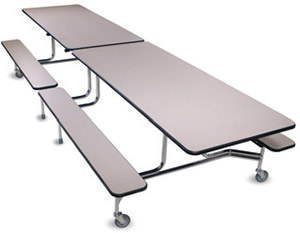
Monrovia Elementary School in Huntsville, Ala., uses 27 BioFit 12-seat mobile folding tables in its cafeteria. As the 13-year table warranty was ending, Facilities Manager Wayne Slater noticed the tables were becoming more difficult to fold and unfold. Since they were in excellent shape otherwise, he contacted BioFit to see if the company could help.

BioFit informed Slater of a new patent-pending component it developed to keep older tables functioning like the day they left the factory: the adjustable torsion cap. Regardless of the manufacturer, mobile folding tables use a lift-assist mechanism to facilitate safe and easy folding and unfolding. Over time, these mechanisms begin to lose torque, meaning it takes more force to fold a table and to keep it from unfolding too rapidly. The BioFit adjustable torsion cap eliminates this issue by enabling the re-establishment of the factory-specified lift capability, facilitating safe operation through the product life cycle and allowing customers to save money by avoiding costly repairs or delaying the need to replace failing tables. Additionally, due to the ease of retrofitting, the cap provides an economical way to refresh the lift on older tables in the field.

BioFit provided caps needed to retrofit the Monrovia Elementary tables at no charge, as the school, a long-term customer, would be one of the first to field-retrofit its tables. The installation proved to be easy and effective.

The adjustable torsion cap comes standard on all new BioFit mobile folding tables with affixed seating.

www.biofit.com

This article originally appeared in the issue of .

Featured

  • classroom with crystal ball on top of a desk

    Call for Opinions: Spaces4Learning 2026 Predictions for Educational Facilities

    As 2025 winds to a close, the Spaces4Learning staff is asking its readers—school administrators, architects, engineers, facilities managers, builders, superintendents, designers, vendors, and more—to send us their predictions for educational facilities in 2026.

  • Malibu High School Campus Completes $102M Phase 1 of Construction

    Malibu High School in Malibu, Calif., recently announced that it has completed phase 1 of construction for its new campus, a news release reports. The first phase consisted of developing and modernizing the site of a former elementary school into a new, 70,000-square-foot, two-story facility.

  • Image credit: O

    Strategic Campus Assessment: Moving Beyond Reactive Maintenance in Educational Facilities

    While campuses may appear stable on the surface, building systems naturally evolve over time, and proactive assessment can identify developing issues before they become expensive emergencies. The question isn't whether aging educational facilities need attention. It's how institutions can transition from costly reactive maintenance to strategic asset management in a way that protects both budgets and communities.

  • textured paper collage shows a school building on fire as a fire truck sprays water into the flames

    Why a Fire Loss Is More than Flames

    We've all seen what fire damage can do to a property, but the types of damage building owners often encounter after a fire loss can exceed expectations. Having full awareness of the different forms of damage properties can sustain helps owners respond faster, reduce continued damage, and get back on the road to recovery in short order.

Digital Edition