Putting the Play in Playground
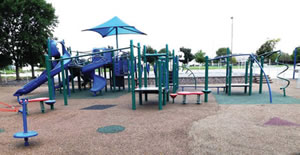
Slip-resistance and permeability for quick drainage were
two benefits offered by Porous Pave XLS all-rubber safety
surfacing — chosen by Community Christian school in the
construction of their new playground.
Community Christian School
(CCS), Willmar, Minn., is an
accredited, inter-denominational
school representing more than 20 churches
in west-central Minnesota. CCS is a K-12
school and home to Eagle’s Nest Pre-School
and Childcare. When CCS installed a new
playground, the selection of the safety
surface gave David Monson, owner, David
Monson Landscaping and Excavating, Kandiyohi,
Minn., the opportunity to use his
imagination to bring the playground to life.
Choosing a playground surface requires
attention to several priorities, starting with
critical fall height. Based on the height of
the highest piece of equipment that a child
can stand on (and fall from), critical fall
height determines the thickness necessary
for safety surfacing to absorb impact. CCS
also wanted slip-resistance and required
permeability for quick drainage leaving no
puddles after rain. The pre-school teachers
wanted smoothness and comfort for young
children sitting on the surface. In Minnesota
winters, outdoor surfaces must be flexible to
withstand freeze-thaw cycles without cracking
or heaving and toughness to withstand
the scrapping of snow blowers and shovels.
Based on all of its requirements, CCS
selected Porous Pave XLS from Porous
Pave, Inc., Grant, Mich. Porous Pave XLS is
an all-rubber safety surfacing made with
chips of rubber processed from recycled
tires. Mixed with a moisture-cured liquid
binder, it forms a solid paved surface that is
safe, highly permeable and flexible.
“We made the playground unique and
special,” says Monson. “The recycled rubber
chips come in different colors. The material
pours in place, so it can form shapes.”
Monson blended a custom mix of earth
tones poured at a depth of two inches for the
main sections of the 12,000-square-foot surface.
Four-inch-deep XLS forms the green
safety pads in the critical fall areas. Circles,
hearts and diamonds in bright primary
colors put the play into the playground.
www.porouspaveinc.com
This article originally appeared in the issue of .