Purple Pride
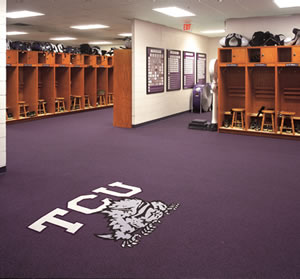
Tandus Centiva’s hybrid resilient flooring is environmentally friendly and helps to promote school spirit across the TCU campus in Fort Worth.
Texas Christian University (TCU) in Fort Worth doesn’t just have school spirit — it bleeds purple.
The color is everywhere on campus — in dorms, academic buildings, on fan gear, and especially all over the newly renovated sports facility. Home to the nationally ranked College World Series Horned Frogs, TCU’s new Baseball Clubhouse features custom color Powerbond® installed throughout. It surrounds players and fans with Purple Pride as they gather to celebrate wins and mourn (rare) losses — all while standing up beautifully to a team’s worth of daily cleat abuse.
This year marks the 50th anniversary of Powerbond, Tandus Centiva’s hybrid resilient flooring that can be found in education settings across the country, such as TCU. It has amassed a virtual shelf full of trophies regarding environmental performance, from third-party certification and recycled content to the fact that it’s 100 percent recyclable. Plus, it supports a healthier indoor environment with low VOC emissions, no antimicrobials, thermal barrier and acoustical enhancements.
Even more, Powerbond can save you time and money. When installing Powerbond Cushion using Tandus Centiva’s #54 Seam Weld or C-XL Water Based Seam Sealer, moisture vapor emission rate (MVER) testing or relative humidity (RH) testing are not required if no free liquids are present and no stained concrete is evident.
Powerbond has proved time and again it can stand the test of time, as it remains in place decades after installation and remains as beautiful and strong today as the day it went in. That’s the beauty of the bond.
www.tandus-centiva.com
This article originally appeared in the issue of .