Natural Light Leads to Energy Savings
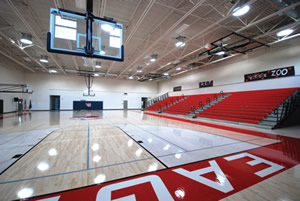
Westside Christian High School benefitted from Solatube Skyvault, which gave students more natural light in the gymand helped the school save on lighting costs.
Westside Christian High School is located in Tigard, Ore. The school leadership decided to build a new gymnasium so the sports teams would have their own place to play for the first time ever.
The school is one of the first in Oregon to use 100-percent LED lighting so energy efficiency was a top focus, but the school leadership really wanted students to have access to natural light in the gym. Since the gym is an interior space, tubular daylighting devices proved the only viable solution.
“Solatube SkyVault were recommended for a number of reasons, including that electric lights would not be needed during the day,” says Dan Quatier, president of Interior Technology. “The school now has the advantage of a naturally lit gym.”
The project used 20 SkyVault M74 units. LED lights on a timer were added as a complementary technology and for use in nighttime lighting.
“The electric lights can be put on a timer, so it’s easy to turn on the lights if they are needed,” adds Quatier. “The gym is beautiful during the day with no lights on.”
“In addition to providing such incredible natural light and reducing energy use, the Solatube units are attractive and fit into the overall ceiling structure in such a way that they enhance the beauty of the space. The gym has quickly become one of the favorite spots for community gatherings due in part to the bright, light atmosphere created by the Solatube. We are very pleased with our choice to put them in and would recommend them to anyone wanting to enhance the quality of any space,” said Dr. Deborah Miller, head of school for Westside Christian High School.
Westside Christian High School sports teams now have a gym to call their own, flooded with daylight.
www.solatube.com
This article originally appeared in the issue of .