Library Transformations
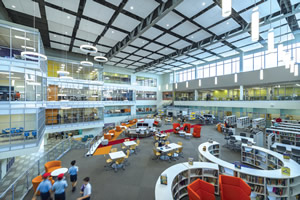
PHOTO BY G. LYON PHOTOGRAPHY
For schools in the 20th century, the media center was the beating heart of creativity and exploration. Yet in recent years, innovation has migrated to classrooms, commons areas and corridors, often leaving the media center without a strong purpose. How can you give your media center new relevance? The answer may be found in the lessons provided by that darling of the new economy, the innovation district.
Innovation districts are typically found in former industrial or manufacturing portions of urban or suburban areas. In an innovation district, large companies work alongside startups, business incubators and entrepreneurs in high-tech and highly-connected spaces. Innovation districts have an energy and synergy that is a perfect model for modern media centers. But how do schools translate innovation district concepts into their existing or new learning spaces?
Develop Density
Innovation districts encourage social networking and connectivity by placing a large number of people and businesses in a small amount of space. When evaluating your media center, look for ways to develop a similar kind of density.
Your media center is most likely located in the center of your school. This makes it prime real estate. However, many older media centers are filled with rows of bookshelves, with little space for more progressive resources. To provide room for innovation, try moving to a more condensed, but high-circulation, collection. And then take advantage of retail strategies such as highlighting popular books or staff favorites with special displays in prominent locations. Fresh publications and classics can be grouped to highlight curriculum themes or current events. Strategies like these will help you shrink your physical collection while growing your everyday impact.
With fewer bookshelves, your media center is ready for an influx of new resources. Carefully curate new programs and equipment, much the way a developer would evaluate new tenants. Your goal should be to create a series of complementary, yet unique, experiences. Consider resources that allow for content creation, such as green screens, audio recording equipment and maker materials. Provide a mixture of seating types and mobile furniture. Plan for amenities that will expand the use of the space to include staff development, training and community meetings. And, perhaps most importantly, relax typical rules by allowing drinks, chatter and laughter.
Synergize
Innovation districts are typically developed around a larger business or institution which attracts smaller companies and entrepreneurs. To give your media center the same impact, think about your space as that anchor institution, and map out the interplay with surrounding learning environments.
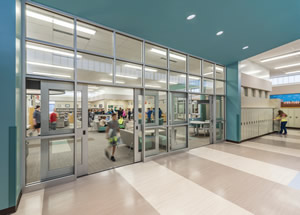
PHOTO BY JAMES STEINKAMP PHOTOGRAPHY
Attract Attention. Make your media center visible through the use of open concepts or storefront windows.
The most successful media center is the one where it is difficult to draw a line around where it starts and stops. A central location with top visibility is key, as is the availability of the space after school hours. The media center’s use should be so critical and obvious to daily life that students and staff think of it as the prime public gathering space, before, during and after school.
For example, during the recent modernization of Middletown High School in Middletown, Ohio, the design relocated the media center to a space directly across from the dining commons and adjacent to extended learning areas. The media center supports its own high-tech programs, but also serves as a drop-in spot for students having lunch or working on a group project. The reimagined media center’s central location and connectivity make it the obvious heart of the building.
When thinking about your media center, don’t be afraid to get creative with adjacent programs. At Carmel High School in Carmel, Ind., a renovated spirit shop is now a business lab where the DECA entrepreneurship students sell coffee and snacks. The reimagined space is located on a main corridor next to the high school’s media center. While the two spaces aren’t connected through curriculum, the foot traffic from one helps the other, much as you would find in an urban downtown.
Think Attraction
Innovation districts are successful because they attract people with new ideas. So, when you are designing or reimagining your media center, try to limit barriers that will discourage students, teachers or community members from using the space.
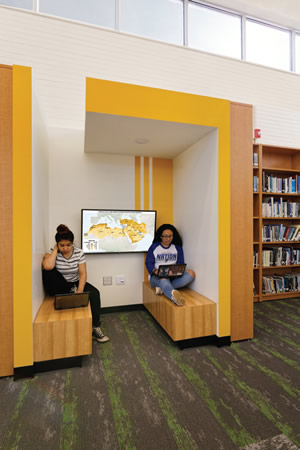
PHOTO BY WILLIAM MANNING PHOTOGRAPHY
Diversify Space. Reduce your book collection to make room for a variety of collaboration spaces that offer something for everyone.
In many new schools, especially at the high school level, the media center is part of an open commons or atrium located near the main entrance. This design strategy maximizes access to the media center and places the most innovative learning environments front and center.
When security is a concern, such as when you are designing for younger students, the media center can still be an inviting space. Large banks of storefront windows provide views into the media center while offering a way to close off the area from the surrounding corridor. And no matter what concept you’re using, make sure you plan for valuable equipment to be located behind a screen or a case, much like in a retail store.
Start Innovating
The same principles being used to transform urban and suburban downtowns can be brought to life in your media center. Think density, think synergy and think attraction, and you will create more than a learning environment. You will create an innovation district.
This article originally appeared in the School Planning & Management July/August 2018 issue of Spaces4Learning.
About the Authors
Steve Herr, AIA, LEED-AP, is director of Design for Fanning Howey, an integrated architecture, interiors and engineering firm specializing in learning environments.
Carla Remenschneider, RID, IIDA, is director of interior design for Fanning Howey, a national leader in the planning and design of learning environments.