University of Indianapolis
PHOTOS © THE ADDISON GROUP
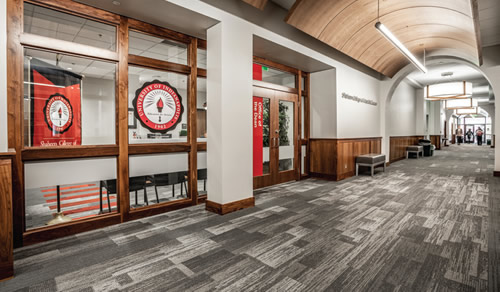
An update of Good Hall on the Campus of the University of Indianapolis has created spaces that are attractive and inviting while retaining the historic character of the facility and supporting the way modern students learn.
Project Snapshot
PROJECT: Good Hall Update
INSTITUTION: University of Indianapolis
LOCATION: Indianapolis, IN
COMPANY NAME: Interface
WEBSITE: www.interface.com
THE CHALLENGE
When the University of Indianapolis (UIndy) was ready to update its historic Good Hall, they turned to DELV Design to keep the legacy of the building intact while updating the interiors to support the way modern students learn.
Amanda Welu, a partner at DELV Design, says, “Part of our solution was not only cosmetic updates, but also opening up and creating a hub so that students could gather to collaborate before or after class, so they could have a between space. We had to find a way to do that and celebrate the legacy of this most historic structure in the design.”
The result is beautiful. Outdated corridors were broadened and furniture and finishes were updated, while spaces were opened up to create those gathering spots outside classrooms. Offices were given more visibility with a storefront design. A floating wood arch overhead accentuates the building’s original architecture, and DELV Design kept the school’s colors and symbols in view throughout.
THE SOLUTION
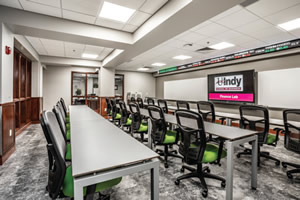 To achieve the warmth and vibrancy she envisioned, DELV Design’s Marisa Gegg chose Interface carpet tile and LVT for the corridors, open spaces, and computer lab. She says, “I used Aerial Flying Colors™ because I needed a coordinating collection of multiple carpet tiles to add texture and wayfinding in the space. The bold red in this collection perfectly coordinated with UIndy’s branding, and I was able to be playful with tile placement because of the multiple options for each colorway.
Interface’s floor design tool was helpful in creating unique pattern layouts for the space. I used Boundary Metallics™ LVT because the lab has a storefront glass system, making it one of the first spaces you see when you walk into the building. The finishes needed to be eye-catching and stunning. The metallic effect in the LVT was the perfect solution because it gives an organic, yet stunning, feel to the lab and the LVT is perfect for chairs with casters.”
IMPACT ON LEARNING
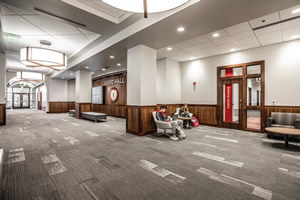 The result? On a recent visit to the school Amanda says she noticed that “there were so many students lounging out there, finishing up, reading, and just hanging out in the in-between times. When classes are changing over, it’s just such an active place. That’s exactly what we were going for.”
Editor’s Review
Today’s students take advantage of gathering spaces outside of lecture halls or classrooms not only for social interaction, but also for informal, collaborative learning sessions. The creation and thoughtful design of welcoming, functional, yet informal spaces in UIndy’s Good Hall supports this new way of shared learning in a visually pleasing environment.
This article originally appeared in the College Planning & Management April/May 2019 issue of Spaces4Learning.