Virginia Commonwealth University to Build New $121M STEM Education Facility

RICHMOND, VA – The Virginia state budget recently signed by Gov. Ralph Northam includes funding for Virginia Commonwealth University to construct a $121-million, 168,000-square-foot, six-floor building dedicated to science, technology, engineering, and math education on the Monroe Park Campus.
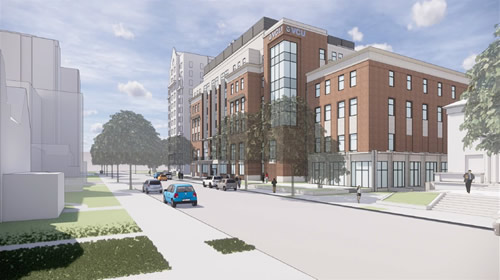
Virginia Commonwealth University STEM building

The building will house lab, classroom, and office space for the College of Humanities and Sciences and will expand existing lab space, facilitate innovative and flexible teaching methods, provide students with instructional and study spaces, and free up space in other College of Humanities and Sciences buildings to better serve students and faculty.

It will include 34 teaching labs; the Math Exchange, an innovative facility for math instruction; a Science Learning Center; two large-capacity classrooms; computer labs; and large- and small-capacity flexible classrooms. It will feature instructional wet and dry labs and classrooms for teaching chemistry, biology, physics, math, psychology, and kinesiology.

The building will be designed by Ballinger and Quinn Evans Architects and constructed by Hourigan.

Featured

  • Abstract tech network data connections with orange, blue glowing dots, lines

    3 Trends for Higher Education to Stay Ahead of in 2026

    As universities enter the new year, the question is no longer whether digital transformation is necessary, but how quickly institutions can convert technological potential into strategic advantage.

  • Beyond Four Walls

    Operable glass walls provide a dynamic solution for educational spaces. They align with today’s evolving teaching methods and adapt to the needs of modern learners. Beyond the functional versatility, movable glass walls offer clean, contemporary aesthetics, slim and unobtrusive profiles, and versatile configurations that cater to the evolving needs of students and educators alike.

  • classroom with crystal ball on top of a desk

    Call for Opinions: Spaces4Learning 2026 Predictions for Educational Facilities

    As 2025 winds to a close, the Spaces4Learning staff is asking its readers—school administrators, architects, engineers, facilities managers, builders, superintendents, designers, vendors, and more—to send us their predictions for educational facilities in 2026.

  • concentric silhouettes of a human head

    How Physical Space Shapes the Mind: Designing for Better Learning Outcomes

    Research in environmental psychology and neuroscience increasingly suggests that the way a room is designed can influence memory, focus, or even a student's sense of belonging.

Digital Edition