New Children’s Center Underway at Boston University

BOSTON, MA – Construction is underway on an expanded facility for Boston University (BU) Children’s Center, a full-time early childhood education program for children of BU faculty and students.
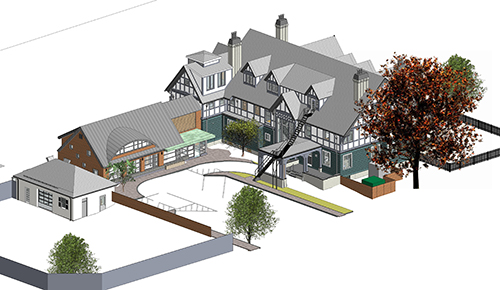
Boston University Chidren's Center

An existing, historic 17,000-square-foot house at 10 Lenox Street in Brookline, MA, will be fully renovated and Kaplan Construction will build a new 3,000-square-foot building in the demolished space that will connect to the main facility. The house will undergo a complete rehabilitation with structural updates, new stairs and elevator, new utility services, and all new mechanical, electrical, and plumbing (MEP) systems.

The outdoor area will feature a combination of natural and manufactured play spaces, and several mature trees will be preserved to achieve a backyard-like atmosphere.

Once completed, the Children’s Center will have the necessary space to accommodate separate infant, toddler, pre-K, and preschool classrooms; free play areas; and indoor gross-motor areas. The building is being designed to meet LEED certification and will be ADA accessible. The Center is scheduled to open in Spring 2020.

Featured

  • Chartwells Launches Campus Dining Evaluation Framework

    Contract food-service management provider Chartwells Higher Education recently announced the launch of BLUEPRINT, according to a news release. The evaluation framework was designed to provide a data-driven and customizable roadmap towards optimizing campus dining services and, by extension, the student experience.

  • school building with glowing circuit board patterns

    AI Is Coming to Schools — But Most School Buildings Still Run on Institutional Memory

    As school districts race to introduce AI into classrooms, administration, and curriculum planning, another conversation is happening behind the scenes: How prepared are school facilities themselves for the operational demands AI will create?

  • Rethinking K-12 Schools as a Continuous Learning Experience

    Most students move through three or more separate facilities during their K-12 journey, yet the built environments they encounter at each stage have traditionally been designed in isolation, with little continuity in spatial language, learning philosophy, or physical resources. Each new school is a reset with different layouts, learning models, expectations, and ways of moving through a building. The next generation of school design is making the case that the first day of kindergarten and the last day of high school can and should feel connected through common support systems and infrastructure in the physical environment.

  • Minnesota District Converts Middle School into Community Hub

    White Bear Lake Area Schools in White Bear Lake, Minn., recently announced the end of a major renovation project that converted a former middle school into a new centralized district and community hub, according to a news release.