Floor Raceway System Wrangles Wayward Wires

A company that makes hardware for managing tech infrastructure has released a new solution for organizing messy cables and wires. The "Smart-Way On-Floor Raceway System" from FSR installs on top of flooring to take the place of having to build a subfloor to accommodate wiring.
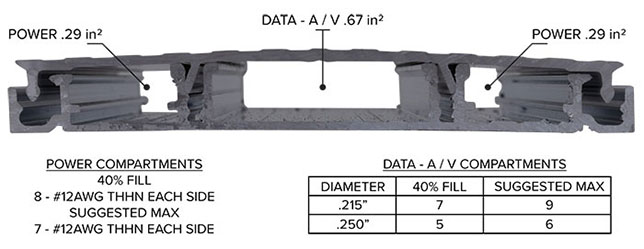
It's sold in 6-foot sections and provides three separate compartments in its track: two for power lines and another for data and AV lines. The design includes centering V-grooves in the track to help locate pilot/clearance holes for securing fasteners.

The Smart-Way is a half-inch high, ADA compliant and available in slate-gray or aluminum finishes. It's sold in 6-foot sections and provides three separate compartments in its track: two for power lines and another for data and AV lines. The design includes centering V-grooves in the track to help locate pilot/clearance holes for securing fasteners. An elbow kit enables the installer to make 45 or 90-degree angles that minimize the bend radius of wire.
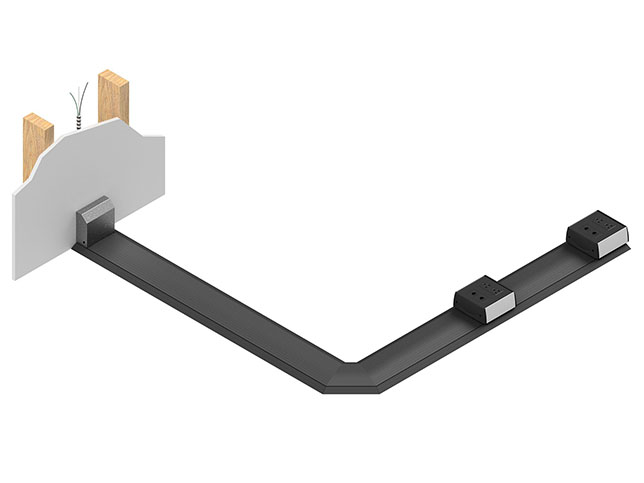
An elbow kit enables the installer to make 45 or 90-degree angles that minimize the bend radius of wire.

Suggested pricing is set at $230 for each segment and $125 for corners.

"It's a very small, unobtrusive bump in the floor," said Chaz Porter, the company's sales director, in a video about the product.

The system is expected to begin shipping in mid-August.

About the Author

Dian Schaffhauser is a former senior contributing editor for 1105 Media's education publications THE Journal, Campus Technology and Spaces4Learning.

Featured

  • University of Oklahoma Announces New Campus Master Plan

    The University of Oklahoma in Norman, Okla., recently announced that it will soon launch a new, comprehensive Campus Master Plan to guide the campus’ physical development during the next decade, according to a news release.

  • Preparing for the Next Era of Healthcare Education, Innovation

    Across the country, public universities and community colleges are accelerating investments in healthcare education facilities as part of a broader strategy to address workforce shortages, modernize outdated infrastructure, and expand clinical training capacity. These projects, which are often located at the center of campus health and science districts, are no longer limited to traditional classrooms.

  • Spaces4Learning Trends & Predictions for Educational Facilities in 2026: Part II

    As education leaders look toward 2026, the design of K–12 and higher education facilities is being reshaped by powerful, converging forces. Survey respondents point to the rapid growth of Career and Technical Education, deeper alignment with workforce and industry needs, and the accelerating influence of AI and emerging technologies.

  • NWEA Report Recommends K–12 Natural Disaster Recovery Strategies

    The Northwest Evaluation Association (NWEA), a K–12 assessment and research organization, recently announced the release of a new playbook for schools and communities recovering from extreme weather events, according to a news release.