Washington Elementary Transforms into STEAM School

Wide Hollow Elementary School recently changed their name to Wide Hollow STEAM Elementary to reflect their new focus on incorporating science, technology, engineering, arts and mathematics across their curriculum.
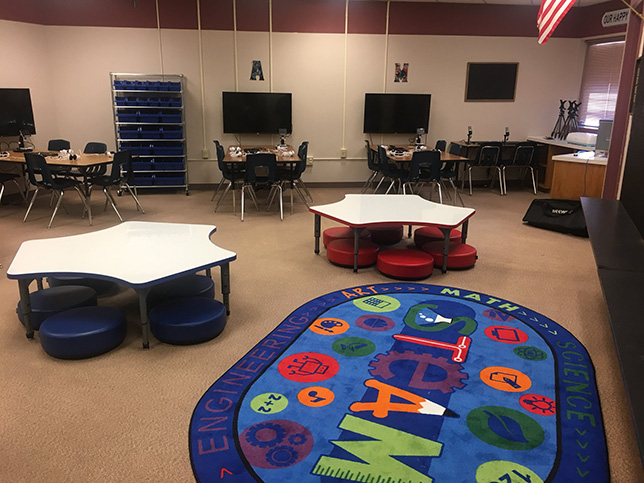
The Washington school transformed its computer lab into a STEAM lab. It was funded by a $10,000 grant from the state Office of Superintendent of Public Instruction.

The Washington school transformed its computer lab into a STEAM lab. It was funded by a $10,000 grant from the state Office of Superintendent of Public Instruction. The lab is now equipped with the following:

  • Art supplies;
  • Age-appropriate robots;
  • Five collaborative digital microscopes that project onto large monitors;
  • A 3D printer;
  • Podcasting stations;
  • Video production station; and
  • A die-cutting station.

Students also have access to programs like Makey Makey, which allows them to design and code using ordinary everyday things.

An emphasis on STEM lessons have increased over the last year so the lab was created to engage and prepare students from a younger age, but also incorporating art and creativity into the process.

Wide Hollow teachers are also starting to incorporate STEAM concepts into core course topics.

“Our main emphasis really is this is a way for students to…communicate, collaborate, solve complex problems…and then be creative,” Principal Rick Ferguson told the Yakima Herald. “Those are skills that are needed in any job, because we really don’t know. A lot of the jobs these kids are going into don’t exist currently. But those four things, the four C’s, they’re going to need those skills.”

About the Author

Yvonne Marquez is senior editor of Spaces4Learning. She can be reached at [email protected].

Featured

  • Preparing for the Next Era of Healthcare Education, Innovation

    Across the country, public universities and community colleges are accelerating investments in healthcare education facilities as part of a broader strategy to address workforce shortages, modernize outdated infrastructure, and expand clinical training capacity. These projects, which are often located at the center of campus health and science districts, are no longer limited to traditional classrooms.

  • Malibu High School Campus Completes $102M Phase 1 of Construction

    Malibu High School in Malibu, Calif., recently announced that it has completed phase 1 of construction for its new campus, a news release reports. The first phase consisted of developing and modernizing the site of a former elementary school into a new, 70,000-square-foot, two-story facility.

  • Recent University of Pennsylvania Projects Receive LEED Certifications

    The University of Pennsylvania in Philadelphia, Penn., recently announced that three of its recent construction projects have earned LEED certifications, according to university news. The Vagelos Laboratory for Energy Science and Technology (VLEST) received a LEED Platinum certification, Amy Gutmann Hall a LEED Gold, and the OTT Center for Track and Field a LEED silver.

  • University of Rhode Island, Gilbane Partner for Three New Residence Halls

    The University of Rhode Island in Kingston, R.I., recently announced a public-private partnership with construction development firm Gilbane, according to a news release. Gilbane will soon start construction on three new residence halls with a total of 1,100 beds: two with apartment-style suites in northwest campus, and a reconstruction of the Graduate Village Apartments for graduate students.

Digital Edition