Edward J. Minskoff Pavilion Completed at Michigan State University

EAST LANSING, MI – The Edward J. Minskoff Pavilion at Michigan State University, designed by LMN Architects,  transforms the Eli Broad College of Business into a unified complex at the forefront of business education. The three-story, 100,000-square-foot structure combines modern teaching facilities with contemporary social spaces, creating a socially active learning environment for students, faculty, corporate partners and alumni to collaborate in forming future generations of business leaders. Technology integration, classrooms, and flexible spaces promote academic and professional excellence, uniquely suited to problem solving in today’s global marketplace.
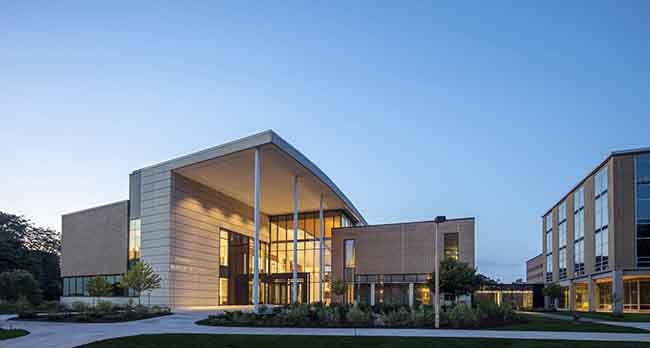
Michigan State University Pavilion

Photo © Adam Hunter, LMN Architects

Located within the heart of the university along the Red Cedar River, the massing and geometry of the building complete the sequence of spaces in the college’s existing facilities while creating a new connection to the river walk. A riparian meadow is designed to both manage storm water and reestablish a natural habitat along the Red Cedar River.

Inspired by Broad College’s team-based community culture, the design weaves together classrooms, team rooms and social spaces at a variety of scales. These program elements permeate all aspects of the academic experience, with an emphasis on collaborative environments supporting the college’s cutting-edge research curriculum.

The pavilion’s masonry, glass and metal exterior express the contemporary functionality of its forward-looking programs while complementing the materials and sensibility of the surrounding campus architecture.

Featured

  • Haws Corporation Marks 120th Anniversary

    Haws Corporation, which provides hydration and emergency safety solutions worldwide, recently announced that the company is celebrating its 120th anniversary this year, according to a news release.

  • Rethinking K-12 Schools as a Continuous Learning Experience

    Most students move through three or more separate facilities during their K-12 journey, yet the built environments they encounter at each stage have traditionally been designed in isolation, with little continuity in spatial language, learning philosophy, or physical resources. Each new school is a reset with different layouts, learning models, expectations, and ways of moving through a building. The next generation of school design is making the case that the first day of kindergarten and the last day of high school can and should feel connected through common support systems and infrastructure in the physical environment.

  • UNH Marks Construction Milestone on Oceanic Exploration Facility

    The University of New Hampshire in Durham, N.H., recently celebrated a major construction milestone with a beam-signing ceremony for the new Center of Excellence for Operational Ocean and Great Lakes Mapping, according to a news release. The facility’s ultimate goal is to support research, training and technical assistance in ocean mapping.

  • St. John Fisher University

    Classroom Revitalization – Basil Hall Room 216

    Established in 1999, the Education Design Showcase is a vehicle for showing off innovative — yet practical — solutions in planning, design, architecture, and construction. St. John Fisher University's Basil Hall Room 216 Classroom Revitalization has been recognized with an EDS 2026 Project of Distinction award in the category of Spaces.