New Fairfield Schools Select JCJ Architecture for New Projects

New Fairfield Schools Select JCJ Architecture for New Projects

New Fairfield Public Schools recently selected JCJ Architecture to design two new school projects — the expansion of the Grades 3 through 5 Meeting House Hill School and a new high school.
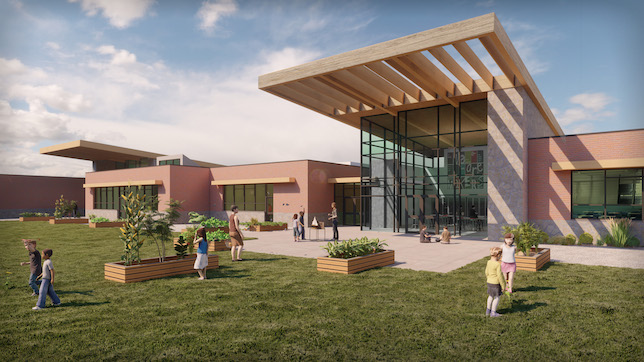
New Fairfield Public Schools recently selected JCJ Architecture to design two new school projects — the expansion of the Grades 3 through 5 Meeting House Hill School and a new high school.

Elementary Exterior

Voters in New Fairfield, Connecticut approved the $113 million school building plan in 2019. About $84 million is needed for the new high school, while $29 million will go to the new addition at Meeting House Hill School. The new 44,000-square-foot addition will accommodate the Consolidated Early Learning Academy (CELA) for PreK-1, while the existing facility will be converted to serve Grades 2 through 5. The high school is planned to be 143,000 square feet.
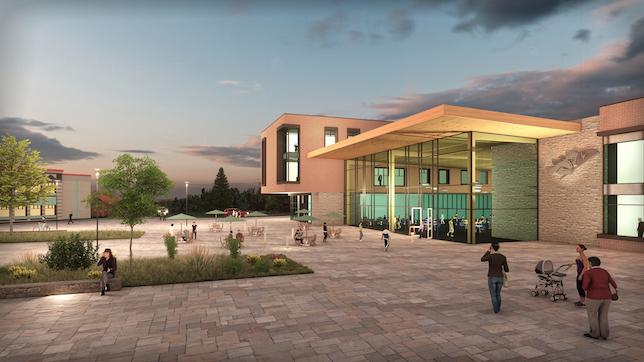
New Fairfield Public Schools recently selected JCJ Architecture to design two new school projects — the expansion of the Grades 3 through 5 Meeting House Hill School and a new high school.

High School Exterior

JCJ Architecture proposed schemes for the new construction to the town’s Permanent Building Committee which the firm says — “focused on ways to maximize use of the site, addressed vehicular circulation, incorporated sustainable principles, created community and collaboration-oriented spaces, and organized programs to maximize building and educational efficiency.”

JCJ Architecture will work with project management firm Colliers International to move the project through the planning and design process. The project is scheduled to break ground in Spring 2021 with CELA slated for completion in 2022 and the new high school in 2023.

About the Author

Yvonne Marquez is senior editor of Spaces4Learning. She can be reached at [email protected].

Featured

  • Spaces4Learning Trends & Predictions for Educational Facilities in 2026: Part II

    As education leaders look toward 2026, the design of K–12 and higher education facilities is being reshaped by powerful, converging forces. Survey respondents point to the rapid growth of Career and Technical Education, deeper alignment with workforce and industry needs, and the accelerating influence of AI and emerging technologies.

  • sapling sprouting from a cracked stone

    Lessons in Resilience: Disaster Recovery in Our Schools

    Facility managers play a pivotal role in how well a school weathers and recovers from a crisis. Whether it's a hurricane, a flood, a tornado, or a man-made event, preparation determines resilience.

  • UNL Kiewit Hall

    Designing for Engineering Excellence: Integrating Sustainability and Wellness at UNLs Kiewit Hall

    Kiewit Hall at the University of Nebraska-Lincoln exemplifies how academic institutions can integrate sustainability and wellness into modern learning environments. With an integrated and collaborative team approach, Kiewit Hall addresses enhanced learning and creativity, physical health, and mental wellness, and fosters a sense of community through innovative design, operations, and policy solutions.

  • Illinois State University Breaks Ground on College of Fine Arts Transformation

    Illinois State University in Normal, Ill., recently held a groundbreaking ceremony for the Wonsook Kim College of Fine Arts transformation project, according to university news. The series of new constructions and renovations will upgrade spaces in Centennial East, the Center for the Visual Arts, and the Center for the Performing Arts, as well as replace the existing Centennial West facility with a new Commons Building.

Digital Edition