"Viral Barrier" Provides Physical Distancing Shield

A U.S.-based company has launched a new line of mobile panels meant to provide shields for people. "ViralBarrier" from Precise Tooling Solutions is intended specifically for K-12 and higher education use.
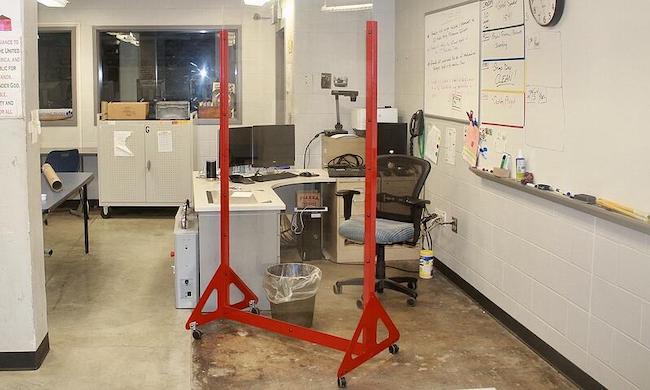
"ViralBarrier" from Precise Tooling Solutions is intended specifically for K-12 and higher education use.

According to the company, the new product features:

  • Shatterproof clear quarter-inch-thick polycarbonate material that can be "easily sanitized";
  • Hooded swivel-casters with brakes;
  • Delivery fully assembled; and
  • An optional mid-level shelf for lightweight digital devices and instructional aids.

The shield is built on a steel truss with an aluminum frame. It's available in a vertical or horizonal orientation and with a choice of "hundreds of colors." The size of the shield is 78 inches by 42 inches.

Production time is estimated to be 18 to 20 days once a purchase order has been submitted.

About the Author

Dian Schaffhauser is a former senior contributing editor for 1105 Media's education publications THE Journal, Campus Technology and Spaces4Learning.

Featured

  • Philadelphia Middle School Facility Earns LEED Gold Certification

    The Alternative Middle Years (AMY) at James Martin Middle School in Philadelphia, Penn., recently received a LEED Gold certification from the U.S. Green Building Council, according to a news release. The School District of Pennsylvania partnered with KSS Architects on the project.

  • GeoCam and UCLA: Modernizing Campus Accessibility Mapping

    In early 2025, UCLA partnered with GeoCam to capture and modernize its pedestrian infrastructure data. The goal was ambitious but clear: to produce a high-accuracy, imagery-backed digital map of every sidewalk, pathway, ramp, and ADA-related feature on UCLA’s 419-acre campus.

  • Johns Hopkins Starts Construction on New Residence Hall, Dining Facility

    The Homewood Campus of Johns Hopkins University in Baltimore, Md., recently began construction on a new residence hall and dining facility, according to university news. The work involves demolishing the existing Alumni Memorial Residence Hall I, which was built in 1923, to make room for the new facility.

  • Building Beyond Simulation: Creating Immersive Ecosystems for Healthcare Education

    Health sciences education is one of the fastest-growing facility types in colleges and universities. The demand for medical, nursing, and allied health professionals is driving the creation and renovation of medical simulation training facilities that provide students with real-world experience through advanced simulation-based learning.