Schools Give Water Fountains the Touchless Treatment
- By Dian Schaffhauser
- 02/23/21
Alongside investments in personal protective equipment, sanitation stations and distancing shields, some schools are earmarking a portion of their federal CARES Act funding to replace their water fountains with touchless versions that don't need continual cleaning.
According to FloWater, one company that makes refill stations, business is gushing. In the past year, CARES Act funds have been used to install "hundreds" of “touchless” refill stations. Just a few of the installation sites include California's Colton Joint Unified School District, the Cherry Creek School District in Colorado, the Minersville Area School District in Pennsylvania and the Z.E.C.A. School of Arts and Technology in North Carolina.
Touchless variations of traditional water fountains may use foot pedals or sensors for operation. All require students to use their own containers.
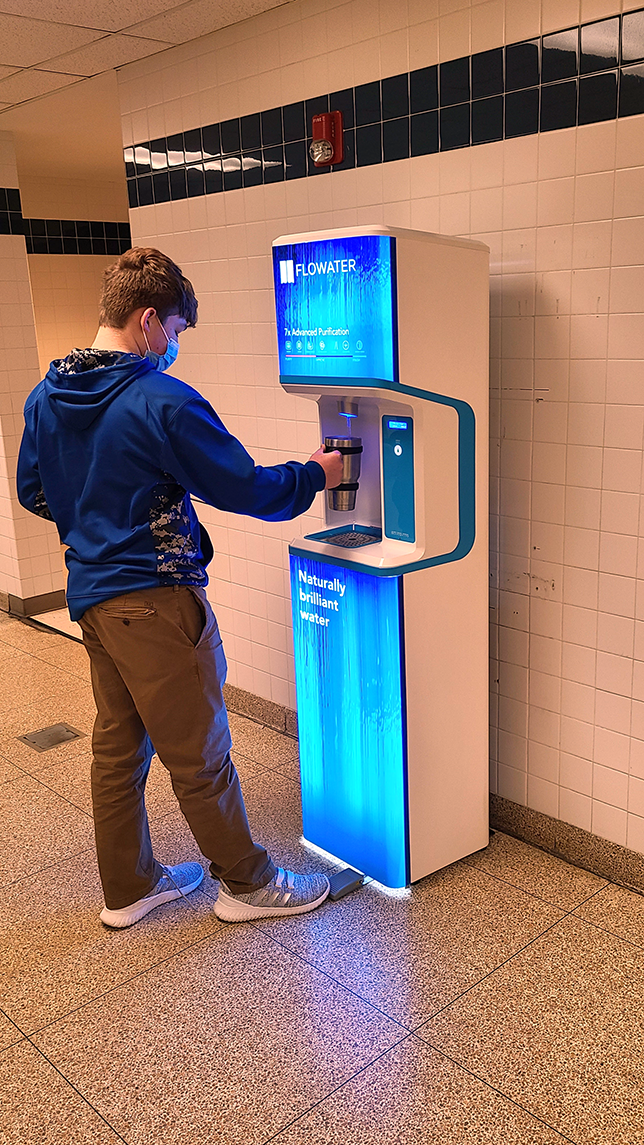
A touchless refill station replaces the standard school water fountain.
Source: FloWater
The company stated that more than 750 of its refill stations have been installed in schools, including 400 with the touchless technology. The refill stations are free-standing and connect to any potable water line within 100 feet. According to the company, most facilities can replace old fountains in the same location without having to obtain building permits or do additional construction.
"This is a 'win' on so many levels for our school community," noted Frank Miranda, superintendent at Colton, in a press release. "We have provided clean drinking water, met the pandemic-driven safety challenge for a safe reopening and provided easy access to the healthiest drink possible."
"Before COVID, we were seeing a high demand as schools looked to eliminate plastic waste and contaminants, like lead, from their drinking water," added FloWater CEO Rich Razgaitis in a press release. "Now, with our fully touchless drinking water solution, we are able to meet the national challenge to replace outdated water fountains."
About the Author
Dian Schaffhauser is a former senior contributing editor for 1105 Media's education publications THE Journal, Campus Technology and Spaces4Learning.