Data Tracker Keeps Tabs on Education Status Worldwide
- By Dian Schaffhauser
- 04/14/21
Most schools in Italy and Russia are open for in-person education, as teachers and
school staff have been prioritized for vaccination. In South Africa and
Myanmar, meanwhile, no education services are available at all, due to
COVID-19, and while vaccinations have been approved for distribution,
they're not available yet to teachers or staff. As for the United
States, education is a mixed story, with schools operating under a
combination of in-person, hybrid and remote learning, even with
teachers prioritized for vaccines.
That data was on a new "global
education recovery tracker," a project developed
by Johns
Hopkins University's eSchool+ Initiative, the World
Bank and UNICEF.
The purpose of the tool is to help 200 countries and territories make
decisions about school reopening and recovery planning. According to
the organizations, the education of 1.6 billion children has been
disrupted over the past year due to the pandemic.
The program has
incorporated data in four areas:
-
Status
of schooling;
-
Modalities
of learning (remote, in-person or hybrid);
-
Availability
of remedial educational support; and
-
Status
of vaccine availability for teachers.
To gather the
information, the countries were divided up among the three partners,
which are each responsible for collecting data from publicly
available sources, including education agencies, state-sponsored
COVID-19 dedicated websites and news sources.
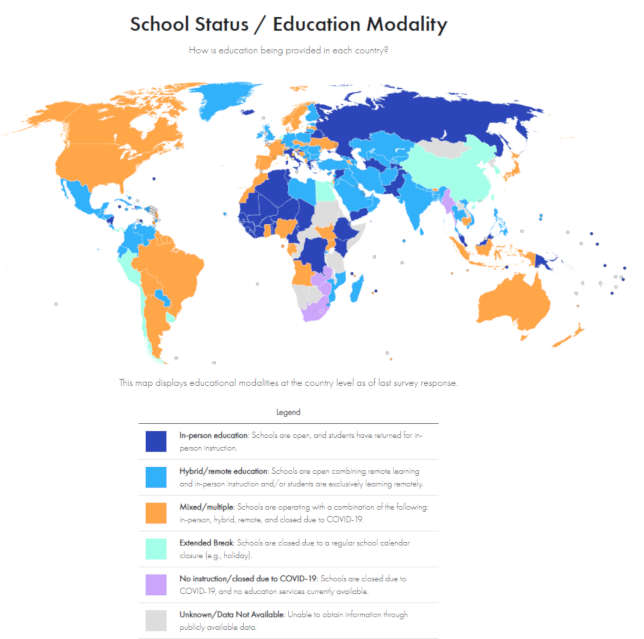
Data through early
March 2021 indicated that 51 countries have returned to in-person
education. In more than 90 countries, including the United States,
students are being instructed through multiple modalities, with some
schools open, others closed and others offering hybrid education.
Some trends noted by the project: In the East Asia and Pacific region
in-person education has mostly returned, with strict physical
distancing measures. South Asia, Central Asia and Europe are mainly
relying on hybrid education where the infrastructure allows. In Latin
America, countries are using mixed approaches that include remote,
hybrid and in-person education.
Also, as of early
March, teachers were not being immunized as a priority group in low-
and low-middle-income countries. Of the 130 countries where vaccine
information was available, more than two-thirds weren't currently
vaccinating teachers as a priority group.
"The learning
poverty rate — the proportion of 10-year-olds unable
to read a short, age-appropriate text — was 53% in low- and
middle-income countries prior to COVID-19, compared to only 9% for
high-income countries," said Jaime Saavedra, World Bank global
director for education, in a statement. "A year into the
pandemic, continued disruptions to schooling, shifts in learning
modalities and concerns for students' well-being are ever greater,
and this learning crisis is getting worse. COVID-19 related school
closures are likely to increase learning poverty to as much as 63%."
He added that the
collection and monitoring of the data is "critically important
to help us understand the magnitude of what support is needed as we
go forward, learning from the major trends observed among countries."
Eventually, the
Tracker will provide additional data on student supports, including
changes to the school year schedule, tutoring and remediation.
The tracker is available on the Johns
Hopkins eSchool+ Initiative website.
About the Author
Dian Schaffhauser is a former senior contributing editor for 1105 Media's education publications THE Journal, Campus Technology and Spaces4Learning.