UArizona Constructing Flexible Research Spaces for Interdisciplinary Projects

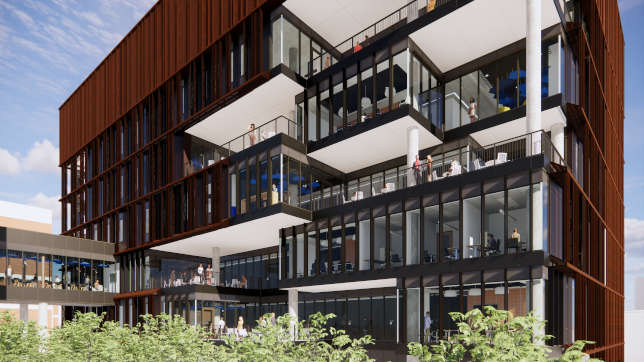
University of Arizona broke ground this week on its new Grand Challenges Research Building, a 115,000-square-foot facility that will house a variety of labs, offices and flexible research spaces.

"Grand Challenges" refers to the second pillar of UArizona's five-pillared "living" strategic plan. The Grand Challenges pillar involves "tackling society’s biggest challenges by enabling discoveries that will fundamentally shape the future."

To that end, the new seven-story building will will serve a wide range of functions. According to UArizona, the ground floor will include "public spaces, study spaces and meeting rooms to support student engagement and instruction."

The three floors above that will include "laboratories and offices dedicated to faculty growth in the James C. Wyant College of Optical Sciences."

The remaining three floors will be "dedicated to research laboratories and offices for centers and cross-campus interdisciplinary programs, including the new Center for Quantum Networks, led by the College of Optical Sciences."
UArizona Constructing Flexible Research Spaces for Interdisciplinary Projects
Source: University of Arizona/ZGF Architects and BWS Architects.

The cost of the building was reported at $99 million. It will be connected to the Meinel Optical Sciences Building. Construction is expected to be completed by February 2024. Design is being handled by ZGF Architects and BWS Architects. Construction for the project is being handled by Kitchell Contractors, which was also "the contractor for the university's Health Science Innovation Building, a 220,000-square-foot building that opened in 2019," according to UArizona.

About the Author

David Nagel is the former editorial director of 1105 Media's Education Group and editor-in-chief of THE Journal, STEAM Universe, and Spaces4Learning. A 30-year publishing veteran, Nagel has led or contributed to dozens of technology, art, marketing, media, and business publications.

He can be reached at [email protected]. You can also connect with him on LinkedIn at https://www.linkedin.com/in/davidrnagel/ .


Featured

  • Building Beyond Simulation: Creating Immersive Ecosystems for Healthcare Education

    Health sciences education is one of the fastest-growing facility types in colleges and universities. The demand for medical, nursing, and allied health professionals is driving the creation and renovation of medical simulation training facilities that provide students with real-world experience through advanced simulation-based learning.

  • Architectural Power for the Modern Campus Landscape

    For generations, an outdoor classroom only required a textbook and a patch of grass. Today, not only has the laptop replaced the printed pages, the rise of agile learning has turned campuses into study halls with students listening to lectures and researching topics from quads, gardens, and plazas. The challenge for architects and facility managers is to provide connectivity without cluttering the landscape with visual eyesores or creating safety hazards with extension cords.

  • USC Launches Major AI Initiative After $200M Gift

    The University of Southern California in Los Angeles, Calif., recently announced that it has launched a “transformational” new AI initiative thanks to a $200M gift, according to a news release. The project will leverage AI toward breakthroughs and innovations in subjects like the health sciences, business, security, and the arts.

  • UCF Modernizes College of Hospitality Management

    The University of Central Florida in Orlando, Fla., recently completed a major renovation effort for the Rosen College of Hospitality Management, according to a news release. The project modernized 77,600 square feet worth of academic classrooms, teaching labs, and collaborative spaces to support both students and faculty.