Penn State Expanding On-Campus Nuclear Reactor
- By Dian Schaffhauser
- 01/13/22
Penn State is expanding its on-campus nuclear reactor and the facility that houses it. The university broke ground on the $9.5-million project, which is intended to accommodate an upcoming equipment donation, facilitate neutron beam research and help grow the nuclear engineering program at the institution.
The upgrades and additional 10,000 square feet of space for the Breazeale Reactor will make room for a $9.8-million donation of a "small angle neutron scattering" (SANS) instrument, which lets researchers measure how neutrons scatter when they interact with a variety of materials. The device also allows for control of a variety of parameters to track when investigating different aspects of material samples at the atomic level, revealing information about their composition and interactions.
The instrument was donated by energy research institute Helmholtz-Zentrum Berlin in Germany, which pulled it out of a decommissioned reactor under operation there. That will be moved to Penn State in late spring 2022, when the new "beam hall" construction is done. When that arrives, according to the university, Breazeale will be the only university research reactor with a SANS facility in the United States, according to Kenan Ünlü, the director of Penn State's Radiation Science & Engineering Center (RSEC) and a professor of nuclear engineering. The addition, he asserted, would position the university as a leader in neutron science.
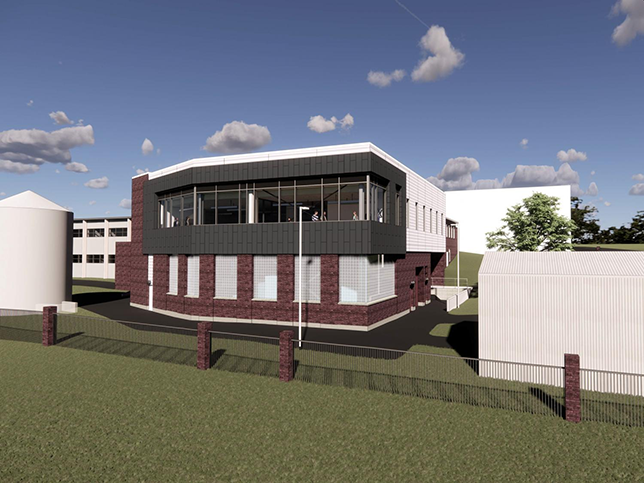
The Radiation Science & Engineering Center (RSEC) is expanding to accommodate growth in nuclear engineering and science at Penn State. Source: Penn State
Ünlü added that the Penn State reactor has undergone several upgrades since its original installation in 1955, under then-U.S. President Dwight D. Eisenhower. The latest one, done in 2018, included installation of five new beam ports. "But we needed a new and expanded neutron beam hall to make full use of the reactor's capabilities and to establish state-of-the-art neutron beam facilities," he explained in a university article.
RSEC is working with the Ken and Mary Alice Lindquist Department of Nuclear Engineering, both part of the College of Engineering, on the latest project. However, other campus units -- including Eberly College of Science; College of Earth and Mineral Science; Penn State Behrend; the Huck Institutes of Life Sciences and the Materials Research Institute -- expect to be able to take advantage of the new instrument for cross-disciplinary study.
Currently, at least half of all "beamtime" requests — the reservations to use neutron science facilities for various research purposes — across the country are rejected due to lack of resources, according to Robert Dimeo, director of the National Institute of Standards and Technology Center for Neutron Research and Penn State alumnus. "This facility provides opportunities to expand research capabilities across Penn State and to help support operations for the scientific community across the United States," he said.
To accommodate staff, faculty, graduate students and visiting scientists, the upgrade will also include office space.
"The education and research mission of the nuclear engineering department and RSEC have enjoyed a strategic partnership for many decades in the College of Engineering," said Jean Paul Allain, head of Nuclear Engineering. "Strengthening already close ties, the college is making a significant investment in both the department of nuclear engineering and RSEC."
About the Author
Dian Schaffhauser is a former senior contributing editor for 1105 Media's education publications THE Journal, Campus Technology and Spaces4Learning.