Whitney Brothers Debuts Superbright LED Creative Cube
Children’s furniture solutions company Whitney Brothers recently introduced a new product that combines a play house cube and a light table. The Superbright LED Creative Cube features an LED light table mounted onto a play house cube, the underside printed with a forest canopy scene that ties into the brand’s biophilia-styled Nature View Collection.
According to a news release, the table itself features a new LED lighting system, a 30.5”-tall play surface, a power cord with an on/off switch, and UL listing to use in both Canada and the U.S. The cube’s green vinyl floor meets state requirements for quiet spaces in Early Learning environments. The product is intended to help save space in classrooms by combining two popular products found in many Early Learning facilities.
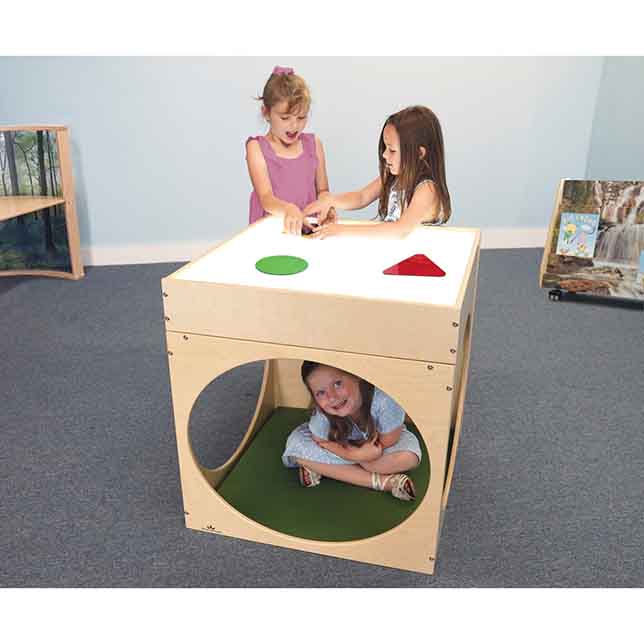
Photo Courtesy of Whitney Brothers
“Our resolute goal is to design educational furniture that helps foster a child’s engagement to their learning environment,” said Mike Jablonski, president of Whitney Brothers. “The Superbright LED Creative Cube will delight and inspire children to learn, explore, discover and play, and we feel the product elegantly illustrates the fresh design thinking that distinguishes our brand.”
According to the news release, the Superbright LED Creative Cube coordinates with other pieces from the company’s Nature View Collection. The biophilic design aims to help reduce students’ stress, enhance creativity and give them the ability to focus clearly. The collection features more than 35 separate furniture pieces that have won various product-design awards.
About the Author
Matt Jones is senior editor of Spaces4Learning. He can be reached at [email protected].