Construction Complete on $6.1M Early Childhood Center

Construction management firm Kraus-Anderson recently announced that it has completed construction on the Early Childhood Center for Pine Island Schools in Pine Island, Minn. The facility stands two stories, covers 20,356 square feet, and cost $6.1 million, according to a news release.

The space includes amenities like new classrooms and a 2,000-square-foot multipurpose area. It also includes an outdoor playground, an indoor playground, administrative space, and ADA accommodations including an elevator. The building also serves as a storm shelter for the safety of students, teachers, and staff.
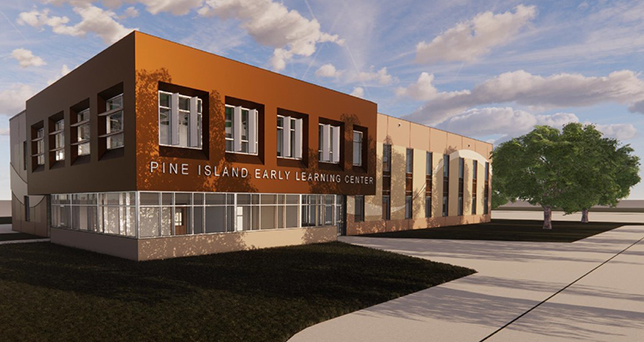
Pine Island Early Childhood Center
Photo Courtesy of Kraus-Anderson

The facility was designed by Wendel Architects.

The news release also reports that over the last five years, Kraus-Anderson has completed more than $1 billion in K–12 projects, ranking 20th in the country in the construction of K–12 facilities.

About the Author

Matt Jones is senior editor of Spaces4Learning. He can be reached at [email protected].

Featured

  • Utah Valley University Opens New Engineering Building

    Utah Valley University in Orem, Utah, recently held a grand-opening ceremony for the new Scott M. Smith Engineering Building, according to a news release. The facility is one of the largest engineering buildings in the state at almost 200,000 square feet, and it plays home to the university’s Smith College of Engineering and Technology (SCET).

  • LAN, Inc. Opens Office in College Station, Texas

    Lockwood, Andrews & Newnam, Inc. (LAN) recently announced the opening of a new office in College Station, Texas, to support its regional client base, according to a news release. The organization provides engineering, design, and program management services for water, wastewater, transportation, stormwater, and education clients in the Brazos Valley.

  • Different Starting Points, Same End Goal

    Higher education campuses can enhance student experience by implementing mobile credentials to streamline building access, on-campus payments, and access to other amenities. This enables students to connect to their campuses through the technology they use most: their mobile devices.

  • Spaces4Learning Trends & Predictions for Educational Facilities in 2026: Part I

    We asked, you answered, and the results are in! Last year, we put out a call for submissions to collect our readership’s opinion on trends and predictions for K–12 and higher education facilities in 2026.