The Right Security Technology for the Job
- By Michael Fickes
- 10/01/14
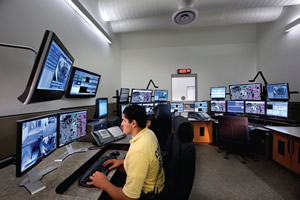
PHOTO COURTESY OF LPA, INC.
Technology is one among many tools that security directors and officers use to protect people and property. Other tools include security master plans, policies and procedures and crime prevention through environmental design, or CPTED.
Technology can be one of the more expensive tools. Managed well, however, technology can cut some costs, including the cost of the technology itself, while making other tools easier for security officers as well as campus police officers to use.
For instance, a key CPTED concept called natural surveillance calls for facility and landscaping designs that provide clear views from inside a building out through windows and across the surrounding grounds. Likewise, it provides for clear views from the outside into buildings. At night, lighting maintains the views. The idea is that criminals do not want and cannot afford to be seen.
College and university facilities that offer nowhere to hide make it difficult to commit crimes.
College and university facilities that offer nowhere to hide may need fewer video surveillance cameras.
Consider policies and procedures. If policies called for every student, faculty member, administrative employee, staff employee and visitor authorized to be on campus to wear a photo identification badge, anyone without a badge would stand out and soon receive a badge or an escort off campus property. The technology, a visitor management system, would make it easier for security officers to control access to campus without requiring the campus police to transform an open campus into a forbidding fortress.
The problem is, many college and university campuses don’t have the right technological tools. “There are generational technology systems that do not talk to each other or interconnect with each other,” says Randy Atlas, Ph.D., AIA, CPP, president of Fort Lauderdale, FL-based Atlas Safety & Security Design, Inc. “Different vendors also provide proprietary systems that cannot be integrated.”
“On campuses that we look at, we rarely find elements of security technology integrated into a single system,” agrees Steve Layne, CPP, CIPM, CIPI, and the CEO of Denver-based Layne Consultants International.
Schools that have managed to build appropriate and tightly integrated technological security systems typically began with a comprehensive security assessment and security master plan.
A security assessment identifies security strengths and weaknesses, technological and otherwise, while the master plan offers a strategy for maintaining the strengths and dealing with the weaknesses over time.
Here’s a look at how the overall process works.
The Security Assessment
The key issues that Layne considers when conducting security assessments include the technology, staffing, emergency operations planning, monitoring contracts (if any) and security training documentation.
“If there is a campus police department, we also look into the way the security department and the campus police divide responsibilities,” Layne says. “Then we consider open or closed campus policies, access control technology for buildings, escort policies, incident reports, reporting methods, distribution policies and Clery Act compliance.
“On the physical security side, we carry out a basic inspection to determine if all systems are up to date. Most fire safety systems are up to date because of codes. But codes do not govern security technologies, and so these efforts always depend upon what the budget can afford.
“In addition, campus police and security departments often don’t have up-to-date technical expertise. Tired of being nickel-and-dimed by vendors, some campuses have brought in computer technicians to provide advice about systems to acquire, integration and scheduling roll-outs to campus buildings.”
Layne’s assessments also inspect police dispatch, which responds to phone calls and radio calls and dispatches officers by radio. He looks at the system that monitors alarms, too, as well as the mass notification system — most campuses have installed these systems today as a swift way to inform the community of campus emergencies.
“Alarms can now be prioritized and routed to a single alarm monitor,” he says. “Some campuses haven’t gotten to this point yet. Older systems typically have a number of monitors strewn across a desk. Everyone should have a video wall today, designed so the operator can see every screen, including a dedicated alarm screen, without changing seats. A monitoring system must also include recording technology and back up disks.
“Finally, we look at one-card systems. Every campus should be using a one-card system, today, for access control as well as vending machines and food service across campus and even for local merchants.”
The Security Master Plan
As previously mentioned, the assessment will note strengths and weaknesses in the existing security plan. In turn, a security master plan addresses the weaknesses outlined by the assessment.
A master plan typically looks forward five years and lays out a prioritized list of improvements to be pursued. Over the five-year period, the security director and perhaps the campus police chief will implement the plan. After about four-and-a-half years, campus authorities — or a third-party consultant — should carry out another security assessment and develop a plan for the next five years that prioritizes more tasks and acquisitions designed to improve security further.
Today’s master plans should probably focus on integrating security technologies, says Layne. That might mean integrating existing systems or beginning to replace systems with technologies that can eventually be integrated.
Today’s Tools
New technologies making their way onto today’s master plans include the cloud, wireless video, wearable video and physical security information management (PSIM).
The cloud offers a new remote storage solution, says Layne. Whatever storage solution a school chooses, it must work with an effective retrieval technology. Layne recalls consulting at a campus with 200 cameras, but the system operators couldn’t tell where the images on the monitors came from. They could see problems but couldn’t react quickly enough to do anything but investigate after the fact.
Layne also says that today’s wireless video systems can transmit images directly to laptops and handheld devices, ensuring that responding security and police officers will know what to expect upon arriving at a scene.
“Among the latest technologies [are] wearable video cameras for officers,” Layne says. “We have found that wearing cameras cuts crime significantly. A suspect can’t lie about what happened if there is a video clip showing what happened.”
PSIM is software that talks to other security technologies and enables the development of graphical user interfaces (GUIs) — single screens with icons that can call up and manage all of the integrated technologies.
The Central Security Station
Every campus should have a central security station, says Layne. While it is possible to monitor and dispatch for remote campuses from one PSIM station, Layne doesn’t recommend it.
“You’re better off with alarm monitoring and security dispatch centers on each campus,” he says. It is safer and more efficient. You can follow the action when an alarm takes place and tell officers what to expect at the scene.”
While campus security and police often operate in the same buildings, today, Layne recommends separate dispatching stations. “Many campuses try to dispatch security and police with one person to hold down costs,” he says. “But what is one dispatcher able to handle: radio dispatch for the police, telephones, access control monitoring and alarms plus video alarms for hundreds of cameras. You really need two dispatchers and a central security station.”
Technology ranks as a key component in a campus security program. It’s important to ensure that technology decisions and implementations enhance the overall program through careful analysis and implementation.
The analysis begins with a security assessment that identifies the appropriate role for technology in the context of an overall campus security program. A five-year security master plan prioritizes and address technology issues, again in the context of the campus security plan. Then, after five years of implementation, you have to do it all over again.
That’s how you get the right technology tools for your campus.
This article originally appeared in the issue of .