Joseph Kushner Hebrew Academy
Project Snapshot
PROJECT: Joseph Kushner Hebrew Academy
LOCATION: Livingston, N.J.
COMPANY NAME: Duro-Last, Inc.
WEBSITE: www.duro-last.com
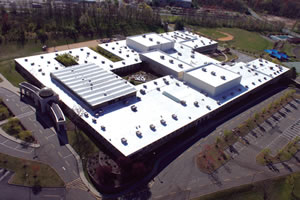
When it became time to replace the roof on the 200,000 square foot Joseph Kushner Hebrew Academy in Livingston, N.J., the school board turned to Duro-Last to get the job done quickly, while school was in session, with minimal interruptions, noise and noxious fumes.
THE CHALLENGE
The EPDM roof was failing and nearing the end of its useful life on the Joseph Kushner Hebrew Academy in Livingston, N.J. Multiple companies offered various solutions for reroofing the 200,000-square-foot facility.
Because the reroofing job was to be done over the existing EPDM system while school was in session, several factors had to be considered prior to choosing a bid. Primarily concerned about the occupants of the building, the Academy’s decision makers wanted a roofing option that would not produce noise or fumes, and would be completed within budget and in a reasonable timeframe.
THE SOLUTION
Although other options were considered, Duro-Last and roofing contractor Complete Roof Systems of Dumont, N.J., were ultimately chosen for several reasons. Not only did Duro-Last’s clean and safe application method meet the requirements necessary for maintaining classes during installation, but it also offered custom prefabrication, mechanical attachment, competitive pricing and an extensive 15-year warranty. The membrane’s high-reflectivity was especially attractive to the board members, as it would save the school energy and money.
No small project, the job required flashing approximately 400 penetrations, including 126 HVAC units, on five different roof levels. The flashings used on these penetrations are prefabricated in a Duro-Last plant, prior to delivery to the job site. This Duro-Last prefabrication approach greatly reduces the risk of roof failure caused by human installation errors.
Prefabrication also helps provide the assurance of a roof that’s leak-proof and virtually maintenance-free, and enables Duro-Last to issue its industry-leading warranty.
Because so much of the roof can be manufactured in a controlled factory environment prior to on-site installation, authorized Duro-Last contractors such as Complete Roof Systems can typically complete jobs more quickly and efficiently and with less disruption than contractors using other systems. The school board was impressed by Complete Roof Systems’ ability to finish the job in just 60 days — less than the estimated timeframe — despite consistently poor weather conditions, which hindered the team’s progress.”
IMPACT ON LEARNING
Following the wishes of the school board, the installation team was successful in reroofing the Joseph Kushner Hebrew Academy with no interruptions to classes; staff and students inside the building during construction were pleasantly surprised at how quiet the installation was.
Schools across America trust the Duro-Last roofing system because it can provide a quick, interruption-free installation, long-term value and is durable and serviceable.
Editor’s Review
A failing roof presents a health threat to the staff and students, mainly due to moisture issues which have been identified to be associated with respiratory problems. The U.S. EPA’s 2010 study entitled, “How does Indoor Air Quality Impact Student Health and Academic Performance?”, says that substandard environmental conditions in schools can cause serious health problems for children. In addition, it states that IAQ also directly impacts student academic performance. The timing of the fix could create major distractions — noise and fumes. You need to be able to concentrate to learn. That is hard to do if there is a lot of noise or other disrupting activities that are inherent to construction projects. The various players in this project — the school administrators, Duro-Last’s representatives and the roofing company — worked together to keep disruptions to a minimum and to make this process as smooth as possible.
This article originally appeared in the issue of .