Not Hush Hush Anymore
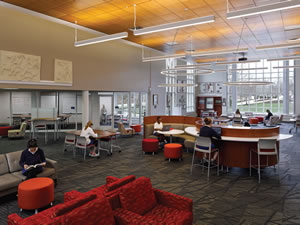
PHOTO COURTESY OF HORD COPLAN MACH./ ROLAND PARK COUNTRY SCHOOL
Today, school libraries are undergoing a transformation —
becoming not just a place to house
resources but one in which to create meaning
from them. Technology is playing a
large role in this change, as virtually every
student has the potential to carry a global
library on his or her device. With this
change, the role of the library has become
more central to the learning environment.
In the evolution from library to learning
commons, we are eliminating the formal,
“whispering only,” reputation that has long
been associated with libraries and instead
bringing together the best of physical
(books) and digital to support self-directed
learning in a rich, interactive environment.
School officials and design teams are
working together to create a contemporary
learning environment that inspires
learning, fosters collaborative study and
promotes engagement with peers. The traditional
library has gone from a stationary,
uncomfortable, one-size-fits-all space with
study carols and a card catalog to a highly
flexible, interactive, technology-rich area.
This new environment is being designed to
be more casual and inviting for students,
inspiring them to come more often, and
stay longer. The learning commons encourages
students to continue their learning
opportunities after school, and have a place
they feel relaxed and safe to participate in
a diverse amount of activities solo or in a
group setting.
PHOTOS COURTESY OF HORD COPLAN MACH./ VAIL MOUNTAIN SCHOOL
Flexibility is a key component within the learning commons — making it easy for students and teachers
to transform the setting based on the learning experience they are
seeking. Easily adjustable desks, chairs, rooms and shelves are
hallmarks of learning commons, in addition to private study areas,
classrooms and/or group workspaces. These spaces may also
include a café, help desk and printing kiosk with librarians serving
as teachers, technology advisors, research assistants, ethical
guides and collaborators.
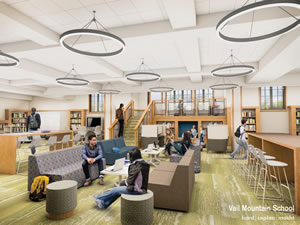
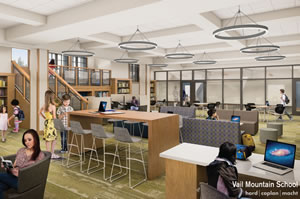
Vail Mountain School was interested in discovering how to
maximize the use of their current library space. They were finding
less need for book shelves and more interest from students
in spaces to collaborate and work in teams, as well as places for
individual study. In this renovation from library to learning commons,
the design entails moving bookshelves along the perimeter
walls and adding small group rooms with glass walls to provide
privacy along with good supervision. A stair and small mezzanine
have been added to connect the learning commons to the outdoor
courtyard. During the construction process, new furniture will
be installed, including tech bars, casual seating, study booths and
tables and chairs for team collaboration, along with additional
outlet locations for ample access to technology.
Although printed books still play a role in these spaces, the digital
technology component is emphasized with access to tablets, computers,
and printers for students who do not have access to them outside
of school and power sources for those who bring their own devices.
PHOTOS COURTESY OF HORD COPLAN MACH./ VAIL MOUNTAIN SCHOOL
At Boulder High School, the library is undergoing a transforming
to an innovative learning commons with many of these themes at
play. By moving bookshelves away from the middle of the room and
relocating the circulation desk, a tech bar space and new furniture
will be added with the circulation desk serving as more of a kiosk or
help desk. Glass garage doors will be installed to connect the learning
commons to the adjacent courtyard and dining commons.
The new library no longer serves as a single use space but
instead supports a variety of activities through various zones and
a flexible design that seeks to integrate the following components:
instruction, group study, informal learning, research, quiet study
areas, and even makerspaces. In many cases, the existing library
is repurposed into a more contemporary learning commons with
the addition of flexible furniture, technology upgrades and other
physical improvements within the current space.
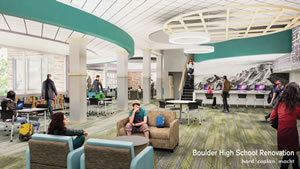
PHOTO COURTESY OF HORD COPLAN MACH./BOULDER HIGH SCHOOL
The existing library at Roland Park Country School was
reimagined into a learning commons with minor revisions to the
“brick and mortar” and while preserving the basic mission of the
library: to provide a center, both physical and virtual, for students
to explore a variety of resource and reading options. The amount
of space dedicated to book storage was reduced and new spaces
were created for research, collaborative work and individual study
with investments in new furniture and technology enhancements.
The learning commons is quickly becoming the academic
heart of the school with thoughtful connections to other spaces.
As technology and opportunities for discovery continue to play
leading roles in the design of our learning environments, we will
see the role of the library to learning commons continue to gather
importance and evolve into a dynamic, media-rich space the supports
and encourages students in quiet study, social connections
and collaboration.
This article originally appeared in the issue of .
About the Author
Adele Willson is Managing Principal of Hord Coplan Macht’s office in Denver, Colorado, and is the Market Sector Leader for the firm’s PK-12 practice.