Construction Progresses on Roux Center for the Environment at Bowdoin College

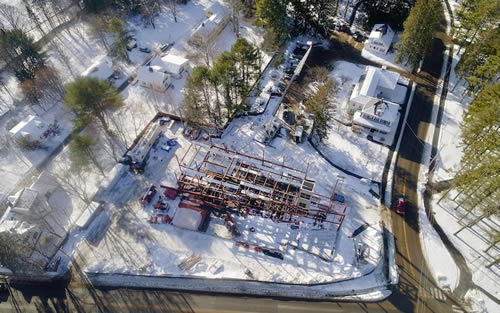
Bowdoin College's newest building—the Roux Center for the Environment—is gradually taking shape, on track to open next fall on the college's Brunswick, ME campus.

The Center, which is located at the corner of College St. and Harpswell Rd., is funded by a lead gift from David and Barbara Roux. When it is open, it will bring together faculty and students from across the College’s curriculum, fostering collaboration and creativity in the teaching and study of the environment.
Bowdoin Roux Center

Besides offices, classrooms, and labs, the 29,167 square-foot center will contain study spaces, a terrace, a green roof, and “The Lantern,” a glassed-in auditorium space at the front of the building. The building is designed to welcome all, to be a space not only for teaching and research but also for performances, community forums, social gatherings, and talks.

To date, Roux Center construction and design team—Warren Construction Group and Cambridge Seven Associates architects—have already erected steel columns and finished the elevator shaft.

The steel structure, along with corrugated metal decks, supports the concrete slab floors, which will be placed over the next couple of months. The concrete for the basement and first floor have already been placed. To work through the winter, there are heaters in the basement and the structure will be enclosed with tarps.

“The pretty stuff will start in late spring and early summer,” says Bowdoin Director of Capital Projects Don Borkowski, who is overseeing the project. “It’ll start to come together then.”

Featured

  • Can AI Help Build Stronger Communities in Student Housing?

    Student housing success is shifting from operational performance to student experience, with belonging now at the center. A recent 2025 report underscores a growing emphasis on student well-being, community, and engagement, signaling that expectations now extend beyond logistics to ensure students feel supported in their living environments. AI is enabling that shift by reducing administrative workload and giving teams more time to focus on meaningful student engagement.

  • Designing for Every Mind

    Learning environments have the power to shape not just what students know, but who they become. When a school is designed with genuine empathy—for the full range of ways students think, sense, and engage with the world—it becomes more than a building. It becomes a catalyst for growth, confidence, and belonging. That is the animating idea behind neurodiverse design, and it is one that is transforming how more architects and designers are thinking about school design.

  • Compton High School

    Compton High School

    Established in 1999, the Education Design Showcase is a vehicle for showing off innovative — yet practical — solutions in planning, design, architecture, and construction. Compton High School has been recognized with an EDS 2026 Project of Distinction award in the category of New Construction.

  • Campus Safety Requires Using Every Resource Available

    Across the U.S., school and campus leaders are facing a security landscape that has changed dramatically over the past decade. Incidents on school property have increased in recent years, with several consecutive years setting record totals. According to analysis of data by CNN, dozens of shootings now occur on school grounds annually across K-12 and higher education environments.