New Interdisciplinary Science and Engineering Building at University of California, Irvine

LMN Architects announces the groundbreaking of the new Interdisciplinary Science and Engineering Building at the University of California, Irvine (UCI). The Interdisciplinary Science and Engineering Building (ISEB) serves UCI’s Henry Samueli School of Engineering, the Donald Bren School of Information & Computer Science, and the School of Physical Sciences.
UC Irvine

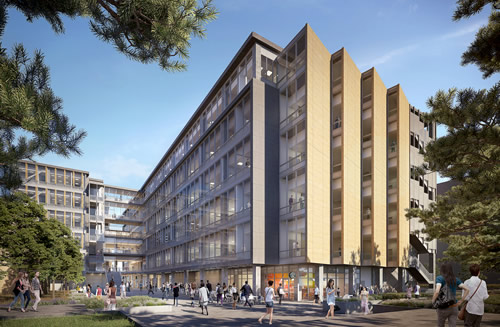
Inspired by the university’s commitment to interdisciplinary science and engineering research and its potential to solve the challenges of today and the future, the building is conceived as a catalyst for research innovation as well as a new model of cross-disciplinary collaboration. The six-story, 204,750-gross-square-foot facility will set a new standard for the future of research programs at UCI. Every aspect of the building’s design is conceived to optimize research functionality, foster social performance, and enrich the overall campus experience.

Each façade of the building responds to its specific environmental conditions, optimizing daylighting, internal comfort, and energy efficiency. The building features a combination of materials that are tuned to the specific environmental conditions, including enhanced clarity low-iron glass, sculptural precast concrete panels, and metal cladding and fins. Indoor-outdoor relationships will be achieved through design strategies that capitalize on the unique, temperate climate and natural beauty of the campus. The project is targeting LEED Platinum certification.

Featured

  • Agricultural Sciences Complex

    Agricultural Sciences Complex

    Established in 1999, the Education Design Showcase is a vehicle for showing off innovative — yet practical — solutions in planning, design, architecture, and construction. The College of Western Idaho's Agricultural Sciences Complex has been recognized with an EDS 2026 Grand Prize award in the category of New Construction.

  • Rethinking K-12 Schools as a Continuous Learning Experience

    Most students move through three or more separate facilities during their K-12 journey, yet the built environments they encounter at each stage have traditionally been designed in isolation, with little continuity in spatial language, learning philosophy, or physical resources. Each new school is a reset with different layouts, learning models, expectations, and ways of moving through a building. The next generation of school design is making the case that the first day of kindergarten and the last day of high school can and should feel connected through common support systems and infrastructure in the physical environment.

  • school building with glowing circuit board patterns

    AI Is Coming to Schools — But Most School Buildings Still Run on Institutional Memory

    As school districts race to introduce AI into classrooms, administration, and curriculum planning, another conversation is happening behind the scenes: How prepared are school facilities themselves for the operational demands AI will create?

  • R.I. District Holds Ribbon-Cutting Ceremony for New Elementary School

    Cranston Public Schools in Cranston, R.I., recently announced the completion of Gladstone Elementary School, according to a news release. The 100,000-square-foot facility serves as a replacement for the 1950s-era former building, and it consolidates the student, faculty, and staff populations of Gladstone and Arlington Elementary Schools.