Keck Center for Science and Engineering Opens at Chapman University

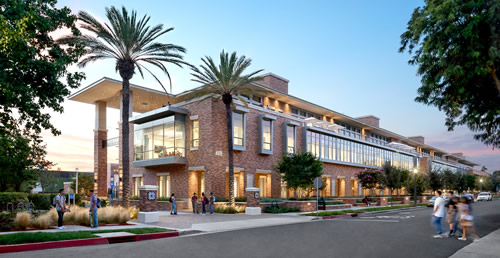
The Keck Center for Science and Engineering on the campus of Chapman University in Orange, CA, opened its doors to students and faculty in August, just in time for the new academic year. Supported by a $20 million grant from W.M. Keck Foundation, this game-changing facility spans nearly an entire city block and offers 140,000 square feet of space for learning, research, and collaboration. Home to Schmid College of Science and Technology, the building will also house Dale E. ’58 and Sarah Ann Fowler School of Engineering, opening in fall 2020.
KECK

The Keck Center is comprised of three floors and divided into two sections: the Hall of Science and the Hall of Technology and Engineering, bridged by a grand arch that serves as the focal point of the building. In total, the center includes 18 teaching labs, 22 research labs, 47 faculty and graduate student offices, three multipurpose classrooms, and six collaboration areas for students and faculty. The facility also features an 833-seat outdoor amphitheater/stadium and a 347-space, two-story subterranean parking garage.

To enhance interdisciplinary work, the Keck Center features high-tech equipment and design elements such as writable glass walls within the science, technology, and engineering labs.

Featured

  • Houston K–12 District Opens New Elementary School

    The Lamar Consolidated Independent School District (Lamar CISD) recently announced the completion of a new elementary school in a western suburb of Houston, Texas, according to a news release. Haygood Elementary School measures in at 110,000 square feet, has the capacity for 854 students, and is the first of three new schools scheduled to be built in the Cross Creek West community.

  • Different Starting Points, Same End Goal

    Higher education campuses can enhance student experience by implementing mobile credentials to streamline building access, on-campus payments, and access to other amenities. This enables students to connect to their campuses through the technology they use most: their mobile devices.

  • Preparing for the Next Era of Healthcare Education, Innovation

    Across the country, public universities and community colleges are accelerating investments in healthcare education facilities as part of a broader strategy to address workforce shortages, modernize outdated infrastructure, and expand clinical training capacity. These projects, which are often located at the center of campus health and science districts, are no longer limited to traditional classrooms.

  • Spaces4Learning Trends & Predictions for Educational Facilities in 2026: Part I

    We asked, you answered, and the results are in! Last year, we put out a call for submissions to collect our readership’s opinion on trends and predictions for K–12 and higher education facilities in 2026.

Digital Edition