Irvine’s New Cadence Park School is District’s Fourth K-8 Campus

The new $44-million Cadence Park School, in Irvine, is the Irvine Unified School District’s (IUSD) 40th school and fourth K-8 campus. The art deco-inspired school was built to accommodate the growth of Orange County’s Great Park neighborhoods and has the capacity to serve up to 1,000 students. The 94,000-square-foot campus encompasses eight buildings on 13 acres and includes a gymnasium with an attached fitness lab as well as outdoor collaboration spaces for all grade levels. Classrooms for grades one through five will have direct access to interior collaboration spaces, and grades six through eight will have access to a quad with an outdoor amphitheater, small group instruction areas, space for outdoor science activities and a garden.
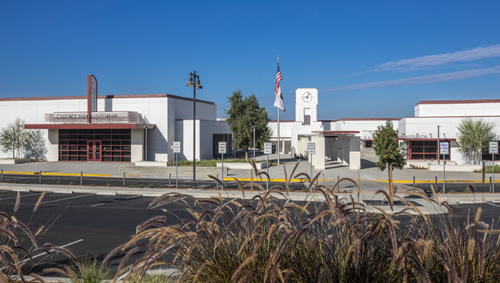
Cadence Park School

The school features an innovation lab with a maker’s space, video production room and flexible learning space with a roll-up door to accommodate a variety of lesson types. A library with a story-telling space will double as a small group work area. C.W. Driver Companies, a premier builder serving California since 1919, worked alongside PJHM Architects on the project.

“We have a long history partnering with IUSD on the construction of its elementary, middle and high school campuses, and are honored to once again work with a school district that is consistently ranked no. 1 in Orange County,” said Jonathan Keene, senior project manager at C.W. Driver Companies. “This new campus will provide a state-of-the-art facility for the Great Park Neighborhoods’ growing population and add to IUSD’s impressive roster of forward-thinking learning environments.”

Featured

  • Embry-Riddle Completes Construction on Research, Lab Facility

    Embry-Riddle Aeronautical University (ERAU) in Daytona Beach, Fla., recently announced the end of construction on a new research and lab facility on campus. The Center for Aerospace Engineering II (CAT II) will support aerospace research and technology development and broke ground last summer.

  • Designing the Bridge Between Inclusivity and Independence in K–12 Schools

    Fostering independence is fundamental to learning and development for K–12 students. It offers many proven benefits, such as enhanced confidence, problem-solving, decision-making, and social skills. However, this foundational objective loses its impact if it’s not accessible and adaptable to all students. Inclusivity plays a critical role in cultivating independence and healthy autonomy for students, fostering positive student learning outcomes by uniting pedagogy with the physical learning environment.

  • Year-Round Schools Require Year-Round Indoor Air Quality Planning

    While many schools are out for the summer, year-round schools follow a more “balanced” schedule with shorter, more frequent breaks spaced throughout the school year. Even though this offers educational benefits, these facilities have less downtime for building maintenance. This can become an issue when facilities managers overlook the importance of routine HVAC maintenance and air duct cleaning services.

  • Planning with Clarity: Using AI to Make Better Campus Decisions, Not Just Better Designs

    Higher education leaders are being asked to make increasingly high-stakes decisions about campus facilities amid greater uncertainty than ever before. Social and economic pressures, shifting enrollment, and evolving learning models compete with growing deferred maintenance needs to strain even the most robust infrastructure budgets.