SMBSD Breaks Ground on New Elementary School
On Feb. 28, 2019, the school district broke ground on a new elementary school located in the south east section of the city."Santa Maria-Bonita has the 11 largest elementary schools and 14 of the 15 largest elementary schools in Santa Barbara County. The construction of this new school is incredibly necessary, greatly appreciated, and cause for celebration," said Superintendent Luke Ontiveros. "This will be the district's 17th elementary school, 21st school overall, and will help us keep pace with growth in the community. We are excited to provide the children of Santa Maria with another inspiring, innovative place to learn and grow."
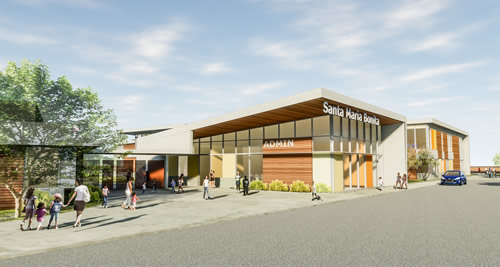
A name has not yet been selected for this K-6 school. A formal naming process will take place while the school is being built. The 10.76-acre parcel the school will sit on is part of the Enos Ranch property, but that will not be the official name of the school.
The elementary school is expected to take a year and a half to build. It will open in August 2020 and can house up to 900 kindergarten through 6th grade students. The land purchase, architectural designs, fees and construction have a combined cost of over $48 million. Desks, computers, books and everything else necessary for a quality educational environment will cost another $2.5 million. About $30 million of the total cost will be paid for by the money from Measure T, SMBSD's school construction bond measure that local voters approved by 61.37 percent in November 2014. The district will fund the remainder of the cost through local developer fees, already received state matching funds, and additional matching funds from the state's recently passed school construction bonds for which the district has applied.
SMBSD Board President Veda Flores recalled the effort to pass Measure T. She was actively involved on the bond campaign committee prior to becoming a board member. "We made a lot of phone calls and spoke to thousands of people in the community about the importance of quality schools," Flores said. "The feedback and support we heard was overwhelming. Santa Maria residents want good schools for their children and their neighborhoods. We are grateful to everyone who voted yes on Measure T and who made this upcoming groundbreaking possible. The new school is a testament to our community's support, and we can't say 'thank you' enough."
In late January, the SMBSD Board of Education awarded the new school construction project to AMG & Associates from Santa Clarita. AMG, which has built a number of schools and city government projects in the state, had the lowest cost responsive bid proposal. AMG also built Jiménez Elementary School in Santa Maria which opened in 2015. "AMG & Associates is very excited to work with the Santa Maria-Bonita School District again," said Albert M. Giacomazzi, president of AMG. "Our first project with the district was Jiménez Elementary School and it was extremely successful. We are confident that the Measure T-funded school will have the same results."
The campus was designed by the national DLR Group architecture firm which has an office in Los Angeles. “DLR Group’s design for Santa Maria-Bonita’s new elementary school creates dynamic educational spaces that accommodate multiple modes of learning on a safe and secure campus," said DLR Group Senior Principal Brett Hobza, AIA. "Multi-story academic buildings and community shared-use performance functions define the edges of the site. The campus plan creates a welcoming interior courtyard that provides outdoor collaboration areas and learning opportunities for students." The school's main buildings are situated in a way that will protect the courtyard learning spaces from much of Santa Maria's seasonal wind. The indoor spaces have also been designed with convenience in mind. “Flexible environments within the school feature movable glass walls and adaptable furniture, allowing students and staff to customize spaces to meet changing educational needs," Hobza added.
Attendance boundaries for the new school will be set by the Board of Education as construction completion nears. Families whose children will attend the new school will be notified well before the start of the 2020-2021 school year.