Work Begins on New First-Year Residence Hall at DePauw University

GREENCASTLE, IN – Site preparation work has begun where the first of four proposed residence halls for DePauw University's first-year students is set to be built.

The new residence hall is one of several investments in the campus planned to enhance the student experience and increase sustainability. The construction of a solar array to convert to renewable energy sources begins in April; the opening of the Ullem Campus Farm is planned for May; and infrastructure work for the Campus Energy Master Plan continues in June.
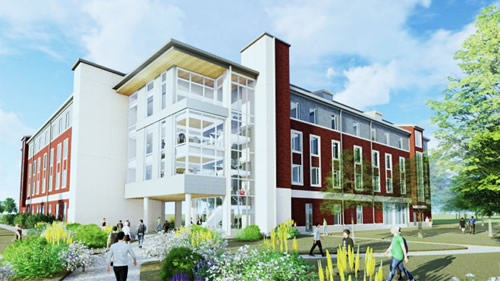
DePauw Residence Hall

This first hall will provide 152 student beds, most of them in double rooms. The first floor of the four-story, 60,400-square-foot building will feature community-living space—the entry, a lounge, a kitchen and the like—and the top three floors will contain students’ rooms. The project will cost approximately $23 million.

Construction work likely will begin in June and is expected to be completed in summer 2020.

Featured

  • sapling sprouting from a cracked stone

    Lessons in Resilience: Disaster Recovery in Our Schools

    Facility managers play a pivotal role in how well a school weathers and recovers from a crisis. Whether it's a hurricane, a flood, a tornado, or a man-made event, preparation determines resilience.

  • Benson Polytechnic High School in Portland, OR

    Preserving Legacy, Designing for the Future

    As historic academic buildings age, institutions face a difficult decision: preserve and adapt or demolish and rebuild. How do we honor the legacy of these spaces while adapting them to meet the needs of modern learners?

  • NWEA Report Recommends K–12 Natural Disaster Recovery Strategies

    The Northwest Evaluation Association (NWEA), a K–12 assessment and research organization, recently announced the release of a new playbook for schools and communities recovering from extreme weather events, according to a news release.

  • Niles West High School Natatorium Renovation

    Natatoriums are highly specialized spaces, and luminaires in this setting face several unique challenges. Perhaps the most significant is corrosion, which is exacerbated by high indoor humidity, condensation, and pool chemicals, often resulting in material degradation in luminaires not certified to perform in corrosive environments.

Digital Edition