UMPI Hosts Groundbreaking for Teaching and Research Greenhouse
PRESQUE ISLE, ME – The University of Maine at Presque Isle (UMPI) celebrated the forthcoming construction of its state-of-the art, four-season Teaching and Research Greenhouse with a Groundbreaking Ceremony on April 25. The greenhouse—a $935,000, 2,400-square-foot structure to be located close to the campus’s year-round composting site—will include two climate-controlled research labs, a teaching classroom, and a faculty office for the Dr. Robert Vinton Akeley, chair of Agricultural Science and Agribusiness.
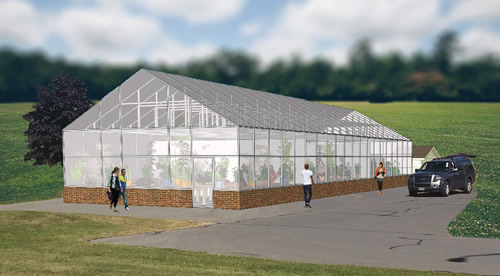
The greenhouse’s state-of-the-art design, by Dirigo Architectural Engineering of Turner, will maximize energy and operational efficiency. PNM Construction of Presque Isle will serve as general contractor on the project. Key features of the greenhouse include double layer polycarbonate transparent panels for the roof and walls, LED grow light systems, watering and ventilation systems—including destratification, exhaust, and circulation fans—and an advanced climate control system and sensor capacity. The technology will help support UMPI’s current research efforts such as disease management, soil fertility, and economic opportunities for Maine growers and agricultural producers.
The greenhouse will be used for various educational and research activities, including courses on plant biology, soil science, plant and crop science, and integrated pest management. Students will receive training in greenhouse crop production, sensor utilization, and analyzing remote monitoring, production, and energy cost data in order to develop a deeper understanding of greenhouse economics that they can bring into the workforce. Faculty will utilize the new facility to host professional development workshops for training in techniques such as seedling production and grafting, and collaborate with community and state partners such as the University of Maine Cooperative Extension, Maine Farm Bureau, Maine Organic Farmers and Gardeners Association, Future Farmers of America, Maine Farmland Trust, the Maine Potato Board, McCain Foods, and the Maine Sustainable Agriculture Association.