Virginia Commonwealth University to Build New $121M STEM Education Facility

RICHMOND, VA – The Virginia state budget recently signed by Gov. Ralph Northam includes funding for Virginia Commonwealth University to construct a $121-million, 168,000-square-foot, six-floor building dedicated to science, technology, engineering, and math education on the Monroe Park Campus.
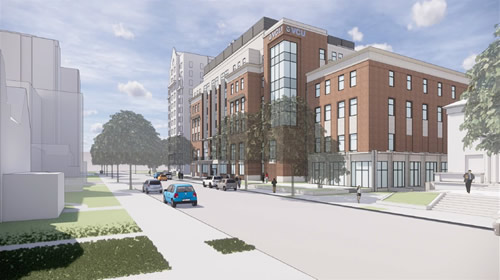
Virginia Commonwealth University STEM building

The building will house lab, classroom, and office space for the College of Humanities and Sciences and will expand existing lab space, facilitate innovative and flexible teaching methods, provide students with instructional and study spaces, and free up space in other College of Humanities and Sciences buildings to better serve students and faculty.

It will include 34 teaching labs; the Math Exchange, an innovative facility for math instruction; a Science Learning Center; two large-capacity classrooms; computer labs; and large- and small-capacity flexible classrooms. It will feature instructional wet and dry labs and classrooms for teaching chemistry, biology, physics, math, psychology, and kinesiology.

The building will be designed by Ballinger and Quinn Evans Architects and constructed by Hourigan.

Featured

  • concentric silhouettes of a human head

    How Physical Space Shapes the Mind: Designing for Better Learning Outcomes

    Research in environmental psychology and neuroscience increasingly suggests that the way a room is designed can influence memory, focus, or even a student's sense of belonging.

  • classroom with crystal ball on top of a desk

    Call for Opinions: Spaces4Learning 2026 Predictions for Educational Facilities

    As 2025 winds to a close, the Spaces4Learning staff is asking its readers—school administrators, architects, engineers, facilities managers, builders, superintendents, designers, vendors, and more—to send us their predictions for educational facilities in 2026.

  • Niles West High School Natatorium Renovation

    Natatoriums are highly specialized spaces, and luminaires in this setting face several unique challenges. Perhaps the most significant is corrosion, which is exacerbated by high indoor humidity, condensation, and pool chemicals, often resulting in material degradation in luminaires not certified to perform in corrosive environments.

  • Benson Polytechnic High School in Portland, OR

    Preserving Legacy, Designing for the Future

    As historic academic buildings age, institutions face a difficult decision: preserve and adapt or demolish and rebuild. How do we honor the legacy of these spaces while adapting them to meet the needs of modern learners?

Digital Edition