$36M Athletics Complex Underway at Orange Coast College
COSTA MESA, CA – Groundbreaking recently took place on the $36 million Orange Coast College (OCC) Kinesiology and Athletics Complex in Costa Mesa, CA. The three-building, 88,000-square-foot complex is one part of a broader project to revitalize and modernize OCC’s campus.
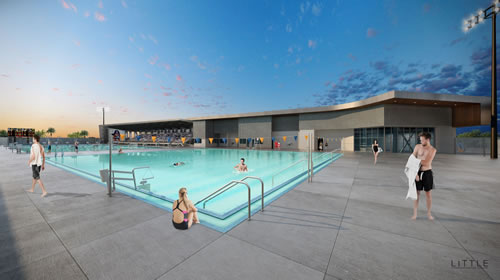
Rendering courtesy of Little Diversified Architectural Consulting
Construction for the complex, by C. W. Driver, will occur in two phases. The first phase includes new construction of a multi-building, one-story complex spanning 58,000 square feet. Phase II will focus on the renovation of the existing 30,000-square-foot building that houses the men’s and women’s locker rooms and existing pool areas.
Upon delivery, the complex will feature division offices, athletic training, adaptive physical education, equipment management, locker rooms/showers, support spaces for the aquatics programs, a 65-meter competition pool with double bulkheads, a 25-meter instructional pool, and a 450-person bleacher space covered by a canopy. The buildings will be interconnected by an overhead shade structure.
Project partners include Little Diversified Architectural Consulting.