Middleton-Cross Plains Area School District Breaks Ground on School

Middleton-Cross Plains Area School District, in Middleton, Wisc., (MCPASD) broke ground in June on the new Pope Farm Elementary School. Battling overcrowding at multiple schools, Eppstein Uhen Architects (EUA) worked with the district to design a future-ready school that embodies MCPASD’s mission: Inclusive. Innovative. Inspiring.

Set adjacent to an expansive conservancy, the design concept for Pope Farm Elementary School reinforces a connection to nature. With a variety of spaces to foster small- and large-group instruction, the school’s design is the result of extensive collaboration with teachers and staff.
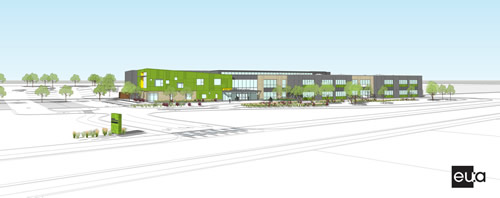
Pope Farm

“We are excited to kick off construction at Pope Farm Elementary School” said Project Manager Robin Savola. “The safe, functional environments within Pope Farm Elementary School will support learners of all kinds, enhancing their reputation as a destination district.” 

The new 525-student elementary school is part of a larger district building project made possible by a successful $138.9 million referendum approved by voters in November 2018. Additional projects include:

  • Renovate and expand Middleton High School; Clark Street Community School will be included in the high school addition/renovation project
  • Add a cafeteria and areas of light interior renovation at Park Elementary School
  • Convert the current Clark Street Community School building into a 4K-early childhood site

Pope Farm Elementary School is set to open for the start of the 2020-21 school year. J.H. Findorff & Son is the Construction Manager on the project.

Featured

  • Building Beyond Simulation: Creating Immersive Ecosystems for Healthcare Education

    Health sciences education is one of the fastest-growing facility types in colleges and universities. The demand for medical, nursing, and allied health professionals is driving the creation and renovation of medical simulation training facilities that provide students with real-world experience through advanced simulation-based learning.

  • How Proactive Maintenance Can Transform Athletic Facilities into Strategic Assets for College Sports

    College athletics is entering one of the most transformative periods in its history. With NIL reshaping financial models and competitive expectations, athletic departments across the country are being asked to do more than ever with increasingly constrained resources.

  • Rethinking K-12 Schools as a Continuous Learning Experience

    Most students move through three or more separate facilities during their K-12 journey, yet the built environments they encounter at each stage have traditionally been designed in isolation, with little continuity in spatial language, learning philosophy, or physical resources. Each new school is a reset with different layouts, learning models, expectations, and ways of moving through a building. The next generation of school design is making the case that the first day of kindergarten and the last day of high school can and should feel connected through common support systems and infrastructure in the physical environment.

  • Georgia State University Opens New Research Tower

    Georgia State University in Atlanta, Ga., recently held a ribbon-cutting ceremony for a new, nine-story, 155,000-square-foot Research Tower, according to university news. Amenities include academic classrooms, a large lecture space, teaching labs, faculty research space, and the uppermost floors reserved for future expansion.