Carnegie Mellon University: Sorrell's Engineering & Science Library Renovation
Carnegie Mellon University 

PHOTOS © ED MASSERY

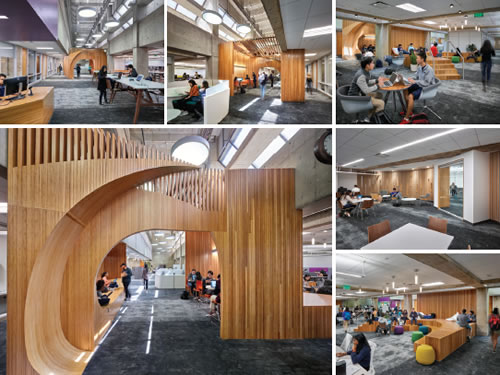
A minimally disruptive renovation has transformed the Sorrell’s Engineering & Science Library at Carnegie Mellon University in Pittsburgh into a learning hub for 21stcentury students.

Three prefabricated bamboo elements are at the heart of this renovation. Designed by GBBN and fabricated locally by two Carnegie Mellon School of Architecture alums, these striking millwork pieces bring warmth to a concrete Brutalist building and help turn it into a place for active learning. Because the space now offers students a wide variety of ways to study and learn, they’re empowered to choose the zone that best suits their project needs and study style.

Near the entrance of the 16,000-square-foot space, “arbors” bring down the scale and provide collaborative zones that feel sheltered within an active, social area. A “portal” in the middle separates the active space near the entry and circulation desk from quiet and focused work zones toward the back. The portal also offers students a range of alternative seating on and around its platform. A multimedia collaborative “den” at the back of the library lets larger groups work without disrupting others.

Additionally, prefabricated glass and metal modular work rooms were added to the space. They keep students visually connected to the rest of the library but provide acoustic privacy for group projects.

All four elements were fabricated offsite and installed in just two weeks during a campus break. To accommodate these changes, a large number of little-used books were moved off-site while 12,000 of the most frequently requested titles remain.

This article originally appeared in the College Planning & Management July/August 2019 issue of Spaces4Learning.

Featured

  • Preparing for the Next Era of Healthcare Education, Innovation

    Across the country, public universities and community colleges are accelerating investments in healthcare education facilities as part of a broader strategy to address workforce shortages, modernize outdated infrastructure, and expand clinical training capacity. These projects, which are often located at the center of campus health and science districts, are no longer limited to traditional classrooms.

  • Malibu High School Campus Completes $102M Phase 1 of Construction

    Malibu High School in Malibu, Calif., recently announced that it has completed phase 1 of construction for its new campus, a news release reports. The first phase consisted of developing and modernizing the site of a former elementary school into a new, 70,000-square-foot, two-story facility.

  • Recent University of Pennsylvania Projects Receive LEED Certifications

    The University of Pennsylvania in Philadelphia, Penn., recently announced that three of its recent construction projects have earned LEED certifications, according to university news. The Vagelos Laboratory for Energy Science and Technology (VLEST) received a LEED Platinum certification, Amy Gutmann Hall a LEED Gold, and the OTT Center for Track and Field a LEED silver.

  • University of Rhode Island, Gilbane Partner for Three New Residence Halls

    The University of Rhode Island in Kingston, R.I., recently announced a public-private partnership with construction development firm Gilbane, according to a news release. Gilbane will soon start construction on three new residence halls with a total of 1,100 beds: two with apartment-style suites in northwest campus, and a reconstruction of the Graduate Village Apartments for graduate students.

Digital Edition