Fairfield University Unveils New Convocation Center

CENTERBROOK, CT – Fairfield University has unveiled a new multipurpose on-campus arena called the Convocation Center, designed by Centerbrook Architects & Planners.

The 3,500-seat facility will serve as the home for the Fairfield basketball and volleyball teams, as well as host concerts, commencements, and other larger on-campus events.
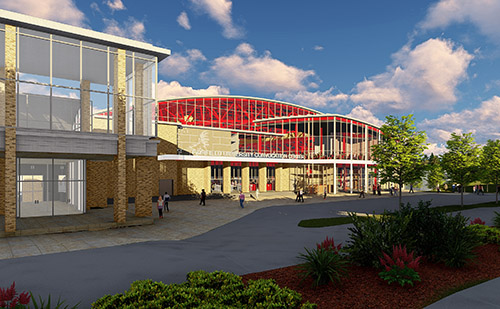
Fairfield University Convocation Center 500

The lower bowl is designed to seat approximately 2,400. A second deck will hold around 1,100, highlighted by The Stag Club, which offers premium seating and hospitality for 150. The design provides unobstructed views from the concourse on both levels. Its 85,000-square-feet also houses locker rooms, a film room, lounge, training rooms, staff offices, and numerous support spaces.

Designed to be modern yet contextual, the estimated $45-million Convocation Center will provide a dramatic arrival with a transparent front entrance that reveals the building’s interior. Natural light enters from three sides of the arena through ample glass that complements the brick façade, which blends with the campus palate. The curved roof is a nod to the current Alumni Hall and many mid-century arenas.

The Convocation Center will replace the 2,500-seat Alumni Hall, which has played host to Fairfield athletics and campus events since 1959. Following its demolition, construction of the new facility is projected to commence in the spring of 2020 and span 18-24 months.


Featured

  • St. John Fisher University

    Classroom Revitalization – Basil Hall Room 216

    Established in 1999, the Education Design Showcase is a vehicle for showing off innovative — yet practical — solutions in planning, design, architecture, and construction. St. John Fisher University's Basil Hall Room 216 Classroom Revitalization has been recognized with an EDS 2026 Project of Distinction award in the category of Spaces.

  • Minnesota District Opens New PreK–12 School

    Gibbon-Fairfax-Winthrop Schools in Gibbon, Minn., recently announced that construction is complete on a new, $68.9-million school for students in grades PreK–12, according to a news release.

  • Rethinking K-12 Schools as a Continuous Learning Experience

    Most students move through three or more separate facilities during their K-12 journey, yet the built environments they encounter at each stage have traditionally been designed in isolation, with little continuity in spatial language, learning philosophy, or physical resources. Each new school is a reset with different layouts, learning models, expectations, and ways of moving through a building. The next generation of school design is making the case that the first day of kindergarten and the last day of high school can and should feel connected through common support systems and infrastructure in the physical environment.

  • Higher Ed is Betting on New Buildings While Quietly Undermining Their Campuses — Here’s Why

    In this climate, the owner’s representative has changed from a delivery-focused advisor to a strategic campus partner. Institutions are increasingly relying on owner’s reps not just to manage, cope, schedule, and budget, but also help evaluate whether a project should proceed at all.