Washington Elementary Transforms into STEAM School

Wide Hollow Elementary School recently changed their name to Wide Hollow STEAM Elementary to reflect their new focus on incorporating science, technology, engineering, arts and mathematics across their curriculum.
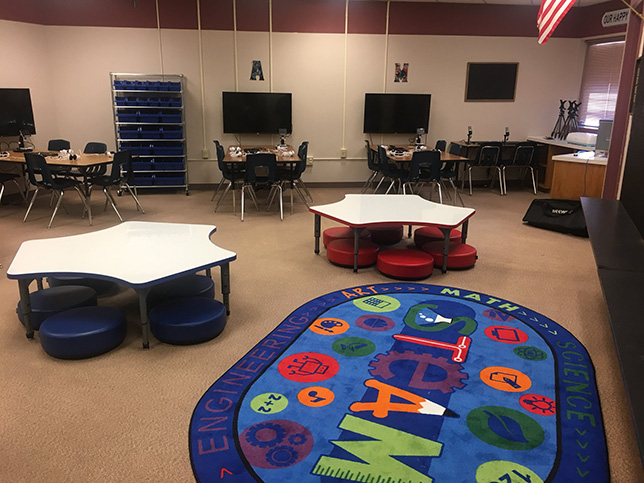
The Washington school transformed its computer lab into a STEAM lab. It was funded by a $10,000 grant from the state Office of Superintendent of Public Instruction.

The Washington school transformed its computer lab into a STEAM lab. It was funded by a $10,000 grant from the state Office of Superintendent of Public Instruction. The lab is now equipped with the following:

  • Art supplies;
  • Age-appropriate robots;
  • Five collaborative digital microscopes that project onto large monitors;
  • A 3D printer;
  • Podcasting stations;
  • Video production station; and
  • A die-cutting station.

Students also have access to programs like Makey Makey, which allows them to design and code using ordinary everyday things.

An emphasis on STEM lessons have increased over the last year so the lab was created to engage and prepare students from a younger age, but also incorporating art and creativity into the process.

Wide Hollow teachers are also starting to incorporate STEAM concepts into core course topics.

“Our main emphasis really is this is a way for students to…communicate, collaborate, solve complex problems…and then be creative,” Principal Rick Ferguson told the Yakima Herald. “Those are skills that are needed in any job, because we really don’t know. A lot of the jobs these kids are going into don’t exist currently. But those four things, the four C’s, they’re going to need those skills.”

About the Author

Yvonne Marquez is senior editor of Spaces4Learning. She can be reached at [email protected].

Featured

  • classroom with crystal ball on top of a desk

    Call for Opinions: Spaces4Learning 2026 Predictions for Educational Facilities

    As 2025 winds to a close, the Spaces4Learning staff is asking its readers—school administrators, architects, engineers, facilities managers, builders, superintendents, designers, vendors, and more—to send us their predictions for educational facilities in 2026.

  • Anderson Brulé Architects Rebrands as ABA Studios

    Anderson Brulé Architects, based in San Jose, Calif., recently announced that it is celebrating 40 years of service by rebranding under a new name, according to a news release. The architectural, interior design, and planning firm will now be known as ABA Studios to refresh its identity underneath a new generation of leadership.

  • Colorado State University Global, SCTE Launch Online Certificate Program

    Colorado State University Global (CSU Global), based in Denver, Colo., recently announced a partnership with CableLabs subsidiary the Society of Cable Telecommunications Engineers (SCTE) to launch an online certificate training program for broadband professionals, according to a news release.

  • Pudu Robotics Launches AI-Powered, Large-Scale Floor Sweeper

    Pudu Robotics recently launched the newest member of its MT1 series of robotic floor sweepers, the PUDU MT1 Max, according to a news release. The AI-powered, 3D perception robotic sweeper was designed for use in large, complex cleaning environments both indoors and semi-outdoors, like parking garages and semi-open building atriums.

Digital Edition