State-of-the-Art Health Sciences Building Underway at Assumption College

WORCESTER, MA – Construction has begun on a new 41,000-square-foot Health Sciences Building at Assumption College. A groundbreaking was held on May 10 and construction will be completed for the fall 2020 semester. The facility was designed by Nault Architects, Lauring Construction is serving as general contractor on the project.
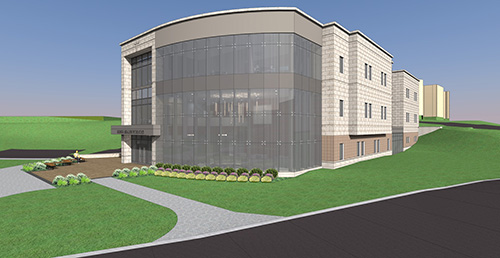
Assumption College Health Sciences Building

The Health Sciences building will house the nursing and physician assistant studies programs set to open in fall 2020, but will benefit students in all disciplines. The nursing floor will feature a large nursing skills lab with seven full-sized hospital beds for teaching patient care. Four simulation labs will have hi-fidelity manikins which can simulate actual patient conditions (vitals, seizures, cardiac arrest, childbirth, etc.) ,all of which can be controlled remotely by a simulation lab technician.

Throughout the spacious building with an interior illuminated by natural light, students will have access to lounges, smaller break-out space and de-briefing rooms and conference rooms, nine offices for faculty and staff, and suites for each of the deans.

Featured

  • Colorado School District Breaks Ground on Unified PK–12 Campus

    The Haxtun School District No. Re-2J in Haxtun, Colo., recently announced that ground has been broken on a renovation/addition project that will unite its two schools, Haxtun Elementary and Haxtun Jr/Sr High School, according to a news release.

  • Deferred Maintenance Issues Growing at Universities, Gordian Reports

    U.S. colleges and universities are falling increasingly behind on facilities maintenance and repair, according to Gordian’s 13th annual State of Facilities in Higher Education report. The deferred capital renewal burden has reached $156 per gross square foot, an 8% increase over the previous year.

  • Universities Continue to Launch Multimillion-Dollar Campus Transformations

    What makes the current wave of campus development especially noteworthy is its emphasis on multi-use functionality and community integration. Institutions are no longer investing solely in academic or athletic facilities in isolation. Instead, they are creating destinations that blend recreation, health, housing, and event-driven economic activity.

  • Designing for Every Mind

    Learning environments have the power to shape not just what students know, but who they become. When a school is designed with genuine empathy—for the full range of ways students think, sense, and engage with the world—it becomes more than a building. It becomes a catalyst for growth, confidence, and belonging. That is the animating idea behind neurodiverse design, and it is one that is transforming how more architects and designers are thinking about school design.