Innovative Boston School Officially Opens in North End

The Eliot Innovation School celebrated the construction of a new, waterfront upper campus with a ribbon cutting ceremony on Oct. 19, attended by Mayor Martin Walsh, Boston Public Schools (BPS) Superintendent Brenda Cassellius, city officials, BPS staff and the community. The $15 million building renovation was part of Mayor Walsh’s $2.08 billion Imagine Boston Capital Plan. It was the final phase of an overall $33 million project to two Eliot school buildings.
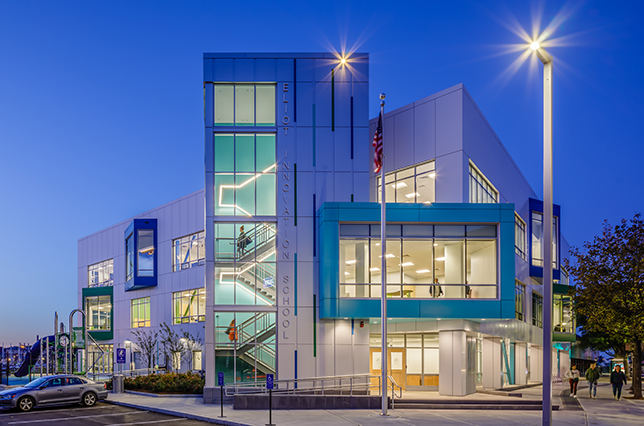
The $15 million building renovation was part of Mayor Walsh’s $2.08 billion Imagine Boston Capital Plan. It was the final phase of an overall $33 million project to two Eliot school buildings.

Finegold Alexander Architects served as the architect, Daniel O’Connell’s Sons were the contractor for the project and design and construction was managed by the City of Boston Public Facilities Department.

The 42,000-square-foot facility is the latest addition to Eliot’s three-campus school. One location serves grades K0-1, another serves grades 2-4 and the new school serves about 400 students in grades 5-8.

Transformed from an office building, the school includes 18 light-filled classrooms; collaborative learning spaces; media, arts and tech/robotics spaces on the first floor; and multi-purpose spaces for community meetings. A new exterior play space is accessible to the community.
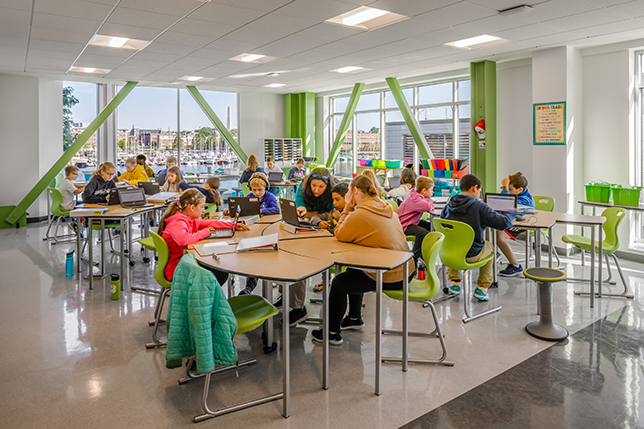
Transformed from an office building, the school includes 18 light-filled classrooms; collaborative learning spaces; media, arts and tech/robotics spaces on the first floor; and multi-purpose spaces for community meetings.

The school features systems that promote sustainability and resiliency, which include:

  • A reflective roof;
  • High R-value building envelope;
  • A storm water retention system;
  • High performance glazing that maximizes natural light;
  • LED lighting with daylight and motion sensors;
  • Low-flow plumbing fixtures; and
  • High-efficiency boilers.

The waterfront location connects students to their natural and historical environment, with access to views to the Boston Harbor and the Freedom Trail just a short walk away.

About the Author

Yvonne Marquez is senior editor of Spaces4Learning. She can be reached at [email protected].

Featured

  • A digital silhouette works at a computer, immersed in a glowing, interconnected world

    How Will AI Transform Learning Space Design?

    For years, higher education has designed learning spaces around technology as a tool for display, capture, collaboration, and connectivity. AI changes that equation.

  • Stanford Online Reveals New Immersive Learning Studio

    Stanford Online recently marked its 30th anniversary with the announcement of a new immersive learning studio, according to a university news release. The studio takes advantage of AI-powered and immersive learning technologies to continue delivering personalized and faculty-led education.

  • Cal Poly Humboldt Starts Construction on Healthcare Education Hub

    California State Polytechnic University, Humboldt in Arcata, Calif., recently announced that work has begun on a renovation project that will turn the Stewart Building into a new Healthcare Education Hub, according to a news release. The university is partnering with Sundt Construction Inc. for construction services.

  • Designing for Every Mind

    Learning environments have the power to shape not just what students know, but who they become. When a school is designed with genuine empathy—for the full range of ways students think, sense, and engage with the world—it becomes more than a building. It becomes a catalyst for growth, confidence, and belonging. That is the animating idea behind neurodiverse design, and it is one that is transforming how more architects and designers are thinking about school design.