Solar Panels Installed to Charge Student Cell Phones

Over the summer, Olathe West High School added solar panels over two picnic tables where students can charge their phones and laptops.
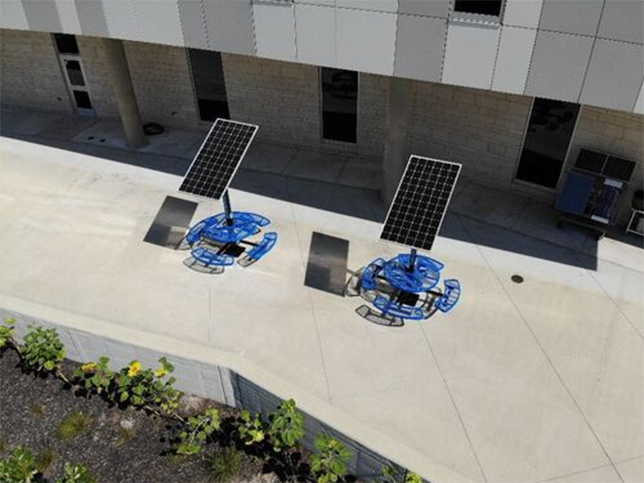
Over the summer, Olathe West High School added solar panels over two picnic tables where students can charge their phones and laptops.  

The solar arrays were installed by MC Power in front of the Kansas school. Each table has eight USB chargers powered by a large solar panel.

Each table has eight USB chargers powered by a large solar panel.

“The kids think it’s pretty cool to charge their devices with the sun,” Cody Janousek, Green Tech Academy facilitator, said to a local newspaper. “There are no wires coming out of the school to the charging stations, so it’s a bit of scientific magic to make it happen. Our phones don’t really use all that much energy, so I emphasize how cool it is to have the phones powered directly by the sun.”

The high school is one of the most sustainable high school buildings in the nation, according to their website. It’s already outfitted with enough solar panels to make their footprint net-zero in energy consumption, Janousek said.

The solar panels are outside of the Green Tech Academy, one of the 15 different 21st Century Academies available at Olathe Public Schools. The Green Tech program is hosted at the high school and teaches students about renewable energy and sustainability.

About the Author

Yvonne Marquez is senior editor of Spaces4Learning. She can be reached at [email protected].

Featured

  • Vanderbilt to Partner with ABM for Campus Preservation and Modernization

    Vanderbilt University recently announced that it has selected ABM Performance Solutions for a preservation and modernization project at its New York City campus, according to a news release. ABM will deliver its end-to-end ABM Performance Solutions (APS) model to manage critical operations during renovation and maintenance.

  • Pitzer College

    Designing for Change in Higher Ed Learning Environments

    Higher education will continue to evolve, and learning environments must evolve with it. By prioritizing adaptable infrastructure, thoughtful reuse, strong energy performance, and wellness-centered design, campuses can create spaces that support learning today while remaining flexible for the future.

  • Harvard Announces Replacement Facility for Native American Program

    Harvard University in Cambridge, Mass., recently announced that construction will begin this spring on a new home for its Native American Program, according to university news. The 6,500-square-foot, all-electric building will stand three stories and serve as the central hub for the Harvard University Native American Program (HUNAP).

  • 144-Year-Old High-School Campus Debuts New Academic Facility

    San Diego High School (SDHS) in San Diego, Calif., recently held a ribbon-cutting ceremony for a new student services and classroom building; the project is part of a larger SDHS Whole Site Modernization project that began in 2022.