Solar Panels Installed to Charge Student Cell Phones

Over the summer, Olathe West High School added solar panels over two picnic tables where students can charge their phones and laptops.
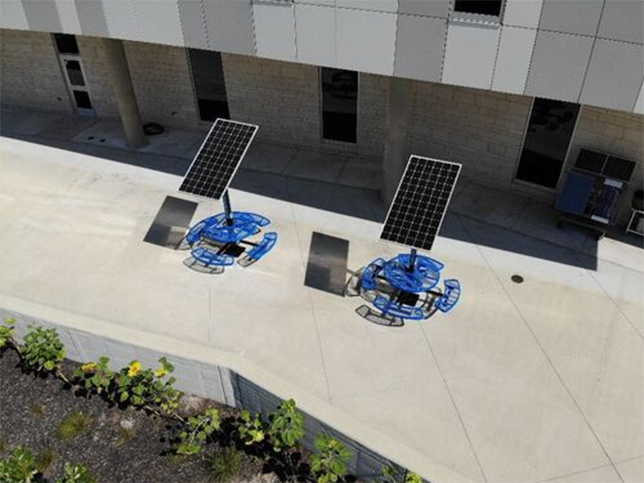
Over the summer, Olathe West High School added solar panels over two picnic tables where students can charge their phones and laptops.  

The solar arrays were installed by MC Power in front of the Kansas school. Each table has eight USB chargers powered by a large solar panel.

Each table has eight USB chargers powered by a large solar panel.

“The kids think it’s pretty cool to charge their devices with the sun,” Cody Janousek, Green Tech Academy facilitator, said to a local newspaper. “There are no wires coming out of the school to the charging stations, so it’s a bit of scientific magic to make it happen. Our phones don’t really use all that much energy, so I emphasize how cool it is to have the phones powered directly by the sun.”

The high school is one of the most sustainable high school buildings in the nation, according to their website. It’s already outfitted with enough solar panels to make their footprint net-zero in energy consumption, Janousek said.

The solar panels are outside of the Green Tech Academy, one of the 15 different 21st Century Academies available at Olathe Public Schools. The Green Tech program is hosted at the high school and teaches students about renewable energy and sustainability.

About the Author

Yvonne Marquez is senior editor of Spaces4Learning. She can be reached at [email protected].

Featured

  • TCU Marks Campus Expansion Milestone

    Texas Christian University in Fort Worth, Texas, recently held a topping-out ceremony to mark progress on a major campus expansion effort including four new residential facilities and a five-story parking garage, according to a news release.

  • Rethinking K-12 Schools as a Continuous Learning Experience

    Most students move through three or more separate facilities during their K-12 journey, yet the built environments they encounter at each stage have traditionally been designed in isolation, with little continuity in spatial language, learning philosophy, or physical resources. Each new school is a reset with different layouts, learning models, expectations, and ways of moving through a building. The next generation of school design is making the case that the first day of kindergarten and the last day of high school can and should feel connected through common support systems and infrastructure in the physical environment.

  • Q&A: How to Prevent Kitchen Grease Fires in Commercial Kitchens

    School cafeterias and university dining halls serve thousands of meals daily, relying on high-heat equipment like fryers, grills, and ovens. While these operations keep students fed, they also generate significant grease-laden vapors. Without proper controls, this grease becomes a silent fire threat. As a certified exhaust cleaning specialist and business coach who has helped hundreds of institutional facilities achieve NFPA 96 compliance, I emphasize that proactive grease management isn’t optional; it’s a core fire/life safety practice.

  • Designing Third Spaces That Do What AI Can't

    In 2026, education is evolving faster than ever. With AI reshaping everything from lesson planning to personalized instruction, schools and universities are turning their attention to what AI can’t replicate: spaces that foster collaboration, community, and creativity.