University of Arkansas Civil Engineering Research Center Breaks Ground

FAYETTEVILLE, AR –Leaders from across Arkansas gathered in early November to celebrate the groundbreaking of the University of Arkansas’ Civil Engineering Research and Education Center at the Arkansas Research and Technology Park. Known as CEREC, the 37,400-square-foot, $13.8-million facility will serve as a research and teaching space for the Department of Civil Engineering and will be a resource for academic, government, and industrial partners across Arkansas.
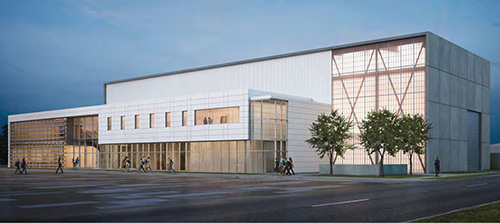
UArkansas Civil Engineering 500

The space includes a high-bay structural testing facility with a four-foot thick “strong-floor” capable of testing large-scale structural systems and components. It will also house a 25-ton rail crane to move heavy materials.

The facility will be the first of its kind in Arkansas. Currently, large-scale structural components must be sent out of state for testing. CEREC will allow academic, industry, and government researchers to conduct cutting-edge experimental research in-state.CEREC will also serve as a living laboratory for several hundred students annually, and the facility has space for 15 faculty members to conduct research.

The project is expected to be complete in spring 2021, with the first classes set to start in the fall of that year.

Featured

  • California K–12 District Finishes Renovations on Multi-Sport Stadium

    The Alameda Unified School District (AUSD) in Alameda, Calif., recently announced the completion of a renovation project on the Encinal Jr. & Sr. High School stadium, according to a news release. The district partnered with Quattrocchi Kwok Architects (QKA) and Bothman Construction on the facility, and funding came from Bond Measure B.

  • New City School

    Turning Crisis into Opportunity: Transforming New City School

    When New City School in St. Louis suffered catastrophic flood damage in July 2022, the event could have marked a serious setback for the 100-year-old institution. Instead, it became a forward-looking opportunity.

  • Different Starting Points, Same End Goal

    Higher education campuses can enhance student experience by implementing mobile credentials to streamline building access, on-campus payments, and access to other amenities. This enables students to connect to their campuses through the technology they use most: their mobile devices.

  • Abstract tech network data connections with orange, blue glowing dots, lines

    3 Trends for Higher Education to Stay Ahead of in 2026

    As universities enter the new year, the question is no longer whether digital transformation is necessary, but how quickly institutions can convert technological potential into strategic advantage.