Clemson Adds Outdoor Lab Site for Construction Science Students
- By Dian Schaffhauser
- 10/22/20
A South Carolina university has just set up a three-acre site to give their construction students a permanent space for hands-on learning. Students in Clemson University's Nieri Family Department of Construction Science and Management will be able to use the "Experiential Learning (XL) Yard" to construct full-scale structures and try out construction equipment. The new yard includes an 1,800-square-foot learning center.
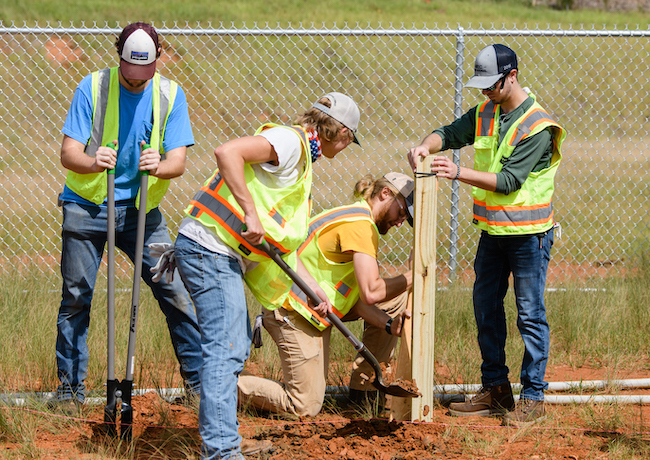
All of the department's students — 250-plus — will take classes at the site, including a safety course and a construction science workshop.
"It's really our outdoor laboratory for construction," said Mike Jackson, chair of the department, in a university article.
The classroom and yard also will also host guest lectures by construction professionals. "They'll bring their expertise to the classroom," added Richard Gauthier, the department's experiential learning program coordinator. "Some will also bring equipment to work with in the yard."
The prompt for developing the space came from the students themselves, who told the university in surveys that they'd like more "hands-on experiences." Students in the program are required to complete 800 hours of internships prior to graduation.
Up to now those students have gained a lot of their practical experience by working on initiatives such as Habitat for Humanity, a nonprofit that builds homes for low-income people who put in sweat equity. Each fall, over the course of a month, students build a Habitat house in connection with homecoming. Those houses are transported to sites in the county, where the new homeowners occupy them.
While that "time-honored project" will continue, students will also be able to construct smaller structures — tiny houses and gazebos — for auctioning off to support future projects at the XL Yard.
The yard was made possible through multiple donations. The classroom was donated by Michael Nieri, a graduate and founder and president of home developer Great Southern Homes. In 2019 Nieri and his wife donated $5 million to the department, which now carries the family name.
"Our corporate partners have been very generous," said Jackson. "We are very blessed to have such a wonderful group of industry supporters at Clemson and in the Nieri Family Department of Construction Science and Management."
About the Author
Dian Schaffhauser is a former senior contributing editor for 1105 Media's education publications THE Journal, Campus Technology and Spaces4Learning.