CIRI To Host Webinar Series Focused on Cleaning and Indoor Virus Transmission
- By Yvonne Marquez
- 11/04/20
The Cleaning Industry Research Institute (CIRI) will host a three-part webinar series called “COVID-19: The Second Wave,” beginning Thursday, Nov. 12. CIRI will host one-hour webinars each month through January 2021.
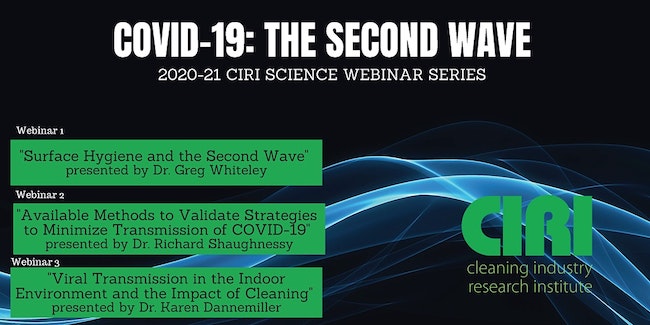
Each presentation is geared toward cleaning professionals and will address new and emerging science related to the transmission of COVID-19. Each live presentation will be about 45 minutes with 15 minutes for Q&A.
“An incredible amount of research into SARS-CoV-2 and COVID-19 has been completed and is ongoing since the start of the pandemic,” said John Downey, CIRI Executive Director. “It’s vital that cleaning and restoration professionals learn ways to apply the research in practical ways to guide best practices.”
The schedule for the webinar series is below:
- “Surface Hygiene and the Second Wave," presented by Dr. Greg Whiteley, Chairman, Whiteley Corporation; Adjunct Fellow, School of Medicine, Western Sydney University. When: Nov. 12 at 4 p.m. EST.
- “Available Methods to Validate Strategies to Minimize Transmission of COVID-19," presented by Dr. Richard Shaughnessy, Director of the Indoor Air Quality Research Program at the University of Tulsa. When: Dec. 16 at 3 p.m. EST.
- "Viral Transmission in the Indoor Environment and the Impact of Cleaning," presented by Dr. Karen Dannemiller, Assistant Professor College of Engineering, College of Public Health, The Ohio State University. When: Jan. 26 at 3 p.m. EST.
Video recordings will be available for those who register but are unable to attend the live event. Continuing education credits are available for each webinar.
Registration for the entire three webinars is $199 for non-CIRI members and $99 for CIRI members. Individual webinars are $99 for non-CIRI members and $49 for CIRI members.
About the Author
Yvonne Marquez is senior editor of Spaces4Learning. She can be reached at [email protected].