UArizona Constructing Flexible Research Spaces for Interdisciplinary Projects

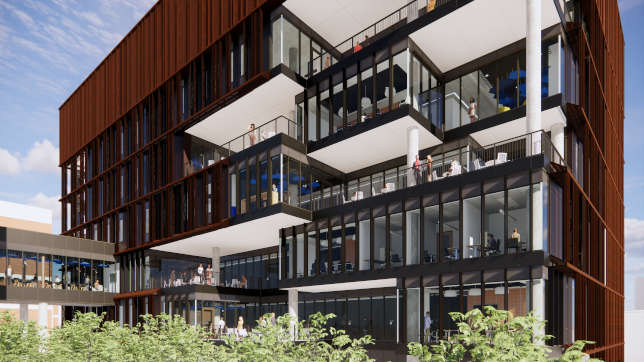
University of Arizona broke ground this week on its new Grand Challenges Research Building, a 115,000-square-foot facility that will house a variety of labs, offices and flexible research spaces.

"Grand Challenges" refers to the second pillar of UArizona's five-pillared "living" strategic plan. The Grand Challenges pillar involves "tackling society’s biggest challenges by enabling discoveries that will fundamentally shape the future."

To that end, the new seven-story building will will serve a wide range of functions. According to UArizona, the ground floor will include "public spaces, study spaces and meeting rooms to support student engagement and instruction."

The three floors above that will include "laboratories and offices dedicated to faculty growth in the James C. Wyant College of Optical Sciences."

The remaining three floors will be "dedicated to research laboratories and offices for centers and cross-campus interdisciplinary programs, including the new Center for Quantum Networks, led by the College of Optical Sciences."
UArizona Constructing Flexible Research Spaces for Interdisciplinary Projects
Source: University of Arizona/ZGF Architects and BWS Architects.

The cost of the building was reported at $99 million. It will be connected to the Meinel Optical Sciences Building. Construction is expected to be completed by February 2024. Design is being handled by ZGF Architects and BWS Architects. Construction for the project is being handled by Kitchell Contractors, which was also "the contractor for the university's Health Science Innovation Building, a 220,000-square-foot building that opened in 2019," according to UArizona.

About the Author

David Nagel is the former editorial director of 1105 Media's Education Group and editor-in-chief of THE Journal, STEAM Universe, and Spaces4Learning. A 30-year publishing veteran, Nagel has led or contributed to dozens of technology, art, marketing, media, and business publications.

He can be reached at [email protected]. You can also connect with him on LinkedIn at https://www.linkedin.com/in/davidrnagel/ .


Featured

  • classroom with crystal ball on top of a desk

    Call for Opinions: Spaces4Learning 2026 Predictions for Educational Facilities

    As 2025 winds to a close, the Spaces4Learning staff is asking its readers—school administrators, architects, engineers, facilities managers, builders, superintendents, designers, vendors, and more—to send us their predictions for educational facilities in 2026.

  • Malibu High School Campus Completes $102M Phase 1 of Construction

    Malibu High School in Malibu, Calif., recently announced that it has completed phase 1 of construction for its new campus, a news release reports. The first phase consisted of developing and modernizing the site of a former elementary school into a new, 70,000-square-foot, two-story facility.

  • Image credit: O

    Strategic Campus Assessment: Moving Beyond Reactive Maintenance in Educational Facilities

    While campuses may appear stable on the surface, building systems naturally evolve over time, and proactive assessment can identify developing issues before they become expensive emergencies. The question isn't whether aging educational facilities need attention. It's how institutions can transition from costly reactive maintenance to strategic asset management in a way that protects both budgets and communities.

  • textured paper collage shows a school building on fire as a fire truck sprays water into the flames

    Why a Fire Loss Is More than Flames

    We've all seen what fire damage can do to a property, but the types of damage building owners often encounter after a fire loss can exceed expectations. Having full awareness of the different forms of damage properties can sustain helps owners respond faster, reduce continued damage, and get back on the road to recovery in short order.

Digital Edition