Chapman University Debuts New Hall of Engineering
Chapman University in Orange, Calif., recently opened a new home for its engineering school. The Swenson Family Hall of Engineering was created through a 31,000-square-foot interior build-out of the university’s existing Keck Center for Science and Engineering. The new wing occupies three floors and features amenities like research and teaching labs, a makerspace and robotics lab, and more. Both the Swenson Family Hall of Engineering and the Keck Center were built by C.W. Driver Companies.
“We were honored to partner with Chapman University in constructing a both beautiful and highly functional hall for its newest academic program, the Fowler School of Engineering,” said Aimee Siemianowski, project executive with C.W. Driver Companies. “Our long history of constructing higher education and research facilities for Chapman University and colleges across the state enabled us to deliver a cutting-edge facility designed to foster collaboration, reconfiguration and blur the lines between teaching and education.”
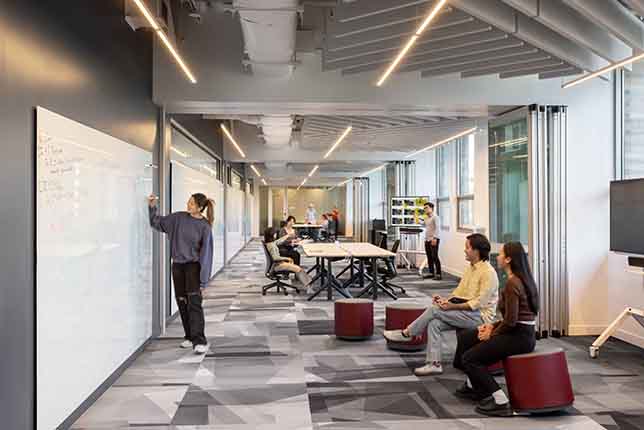
Photo credit: Lawrence Anderson
The new wing’s first level serves as a collaborative student space and features a large gallery that connects to the rest of the Keck Center. The second floor includes research pods, teaching labs and study alcoves, while the third features a faculty suite that includes workspaces, meeting space and collaboration zones. The facility is named after Jim Swenson and the Swenson Family Foundation, which previously contributed $5 million to Chapman University.
“The opening of the Keck Center’s science wing in 2018 signaled a tremendous step forward in the STEM fields at Chapman University,” said Collette Creppell, vice president of campus planning and design at Chapman University. “Thanks to the valuable expertise of C.W. Driver Companies in building the Swenson Family Hall of Engineering, our new Fowler School of Engineering has a place to call its own. The facility will be paramount to attracting high-quality faculty and talented students pursuing undergraduate and graduate-level study of engineering, which in turn will help meet the growing demands of the California economy.”
The university and C.W. Driver Companies also partnered with AC Martin Partners, Inc. for the facility’s design.
About the Author
Matt Jones is senior editor of Spaces4Learning. He can be reached at [email protected].