Teknion Introduces Space-Saving Kupp Flip-Top Tables
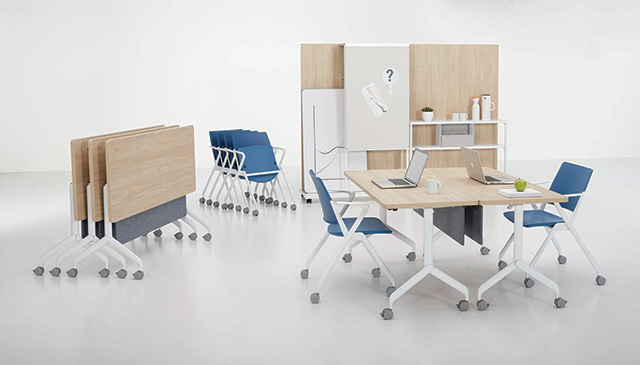
Kupp Flip-Top Tables

Teknion has launched a new addition to its Kupp furniture collection: the Kupp Flip-Top table. Featuring angled legs that enable straight-line nesting and integration with the Kupp horizontal nesting chair, the tables are designed for flexibility and efficient storage, the company said in a news announcement.

The tables feature a surface-long handle that allows users to flip the tabletop for storage or reconfiguration, and the work surface is finished on both sides, providing a "clean and polished aesthetic" in both the horizontal and vertical position, the company said. Customization and accessory options include a modesty panel, power/data cut-out, and bag hook. The tables are available in depths of 24 inches and 30 inches and in widths ranging from 42 inches to 72 inches, providing a wide variety of size options.

"With an emphasis on practicality, style, and adaptability, these tables empower individuals and organizations to create dynamic and efficient workspaces," said Martin Geoffroy, director of product management - expansion at Teknon, in a statement. "Its versatile linking capability opens up endless possibilities for creating collaborative work areas, making them an ideal choice for dynamic and evolving workspaces."

For more information, visit the Kupp site.

About the Author

Rhea Kelly is editor in chief for Campus Technology, THE Journal, and Spaces4Learning. She can be reached at [email protected].

Featured

  • Chartwells Launches Campus Dining Evaluation Framework

    Contract food-service management provider Chartwells Higher Education recently announced the launch of BLUEPRINT, according to a news release. The evaluation framework was designed to provide a data-driven and customizable roadmap towards optimizing campus dining services and, by extension, the student experience.

  • school building with glowing circuit board patterns

    AI Is Coming to Schools — But Most School Buildings Still Run on Institutional Memory

    As school districts race to introduce AI into classrooms, administration, and curriculum planning, another conversation is happening behind the scenes: How prepared are school facilities themselves for the operational demands AI will create?

  • Rethinking K-12 Schools as a Continuous Learning Experience

    Most students move through three or more separate facilities during their K-12 journey, yet the built environments they encounter at each stage have traditionally been designed in isolation, with little continuity in spatial language, learning philosophy, or physical resources. Each new school is a reset with different layouts, learning models, expectations, and ways of moving through a building. The next generation of school design is making the case that the first day of kindergarten and the last day of high school can and should feel connected through common support systems and infrastructure in the physical environment.

  • Minnesota District Converts Middle School into Community Hub

    White Bear Lake Area Schools in White Bear Lake, Minn., recently announced the end of a major renovation project that converted a former middle school into a new centralized district and community hub, according to a news release.